Greater London · Extract fan cleaning
Extract fan cleaning in Mile End, Greater London
Extract fan cleaning across Mile End and nearby, booked around your opening hours and finished with a written report and pictures.
- A motor area thick with grease
- Rough running from the extract fan
- A fan left out of previous cleans
When it’s something else
We’d rather tell you now than book work that won’t help, so these are the things it will not cover:
- An impeller that is bent or split
- Grease in the canopy and ductwork
- An undersized fan that cannot cope
If you are not sure, just call us on 0345 646 2711 or send us an email and we’ll give you a straight answer before you book.
Parts of the system we cover
- Axial fans
- Fan housings
- Centrifugal fans
- Roof-mounted fans
- Discharge points
- In-line fans
Extract fan cleaning for kitchens and businesses in Mile End
In Mile End, as everywhere we work, the fan follows a set routine: isolated first, then opened, scraped and degreased. The result is photographed for your records. The work covers fan housings, in-line fans and discharge points, and the jobs we see most are a fan left out of previous cleans and a motor area thick with grease.
Across London, many commercial kitchens are squeezed into basements and narrow back-of-house spaces, and the duct may run up through several floors before it discharges at the roof. For a kitchen in Mile End, that normally means a longer system to clean and more access panels to plan around.
Insurers, fire officers and environmental health officers all look at records. That’s why every job is written up in a report with pictures, and grease extract cleans come with a TR19® certificate issued through the BESCA Vent Hygiene Elite portal.
- Place
- Mile End (E3, E1, E14)
- Region
- Greater London
- Records
- TR19® certificate and photo report
- Price
- A fixed price before we start
- Hours
- When your site is closed, plus a 24/7 line
- Telephone
- 0345 646 2711
- Updated
- 30 October 2026
Kitchen extracts in Mile End
There are about 589 cafés, restaurants and staff canteens and about 184 takeaways in and around Mile End, up to about a mile and a half out, according to the Food Standards Agency’s register. Any of those kitchens with a canopy relies on a fan that gathers grease as it runs. Kitchens in Mile End get their food hygiene inspections from Tower Hamlets council. The cleanliness of the kitchen and its equipment, extraction included, is part of what they check. Keeping each certificate and photo report on file helps show the extract is looked after. The fire and rescue service for Mile End is London Fire Brigade. Its fire safety officers can audit commercial kitchens, and grease in the extract is part of a kitchen’s fire risk.
Healthcare kitchens can’t easily close, so their extracts are cleaned overnight or between meal services; the nearest hospital to Mile End is St Clement's Hospital, about under half a mile north-east. If you run a café or takeaway near Limehouse station, early starts and late finishes leave little time to clean, so overnight extract cleaning suits. Where a hall near Holy Trinity Church, or anywhere in Mile End, hosts lunch clubs or events, its extract gathers grease just as a café’s does.
Mile End is about 2 miles east of Whitechapel, in Greater London. If you need extract fan cleaning in Mile End, it’s easy to get a fixed quote: please ring 0345 646 2711 or drop us a line. Our area covers London and the South East, including Mile End. Mile End is one of 764 towns, villages and districts in Greater London we cover for extract fan cleaning.
Here we cover the E3, E1 and E14 postcode area for extract fan cleaning. If you need extract fan cleaning at premises on Bow Road, Bale Road and Toby Lane or a nearby road, we can help. Main roads around Mile End include the A1205, so getting to you is simple for evening and night visits. If your site is just outside Mile End, we cover Bow (1 mile north), Bow Common (1 mile south-east), Bromley (1 mile east), Limehouse (1 mile south) and Donnybrook Quarter (1 mile north). Larger places within reach include London (3 miles south-west), City of Westminster (5 miles west), Marylebone (5 miles west), Kensington (8 miles west), St Pancras (4 miles west) and Walthamstow (4 miles north).
Near you in Mile End
In Mile End, that means kitchens and buildings near Central Foundation Girls' School, Malmesbury Primary School and Mile End Park. For rail, the closest station is Limehouse station, about 0.9 miles south of the centre. A little further out are St Clement's Hospital (less than half a mile north-east) and Museum of the Book (0.8 miles south). Not far away are Old Ford Island and Tower Hill.
Common questions in Mile End
Who is the fire and rescue service for Mile End?
London Fire Brigade is the fire and rescue service for Mile End. Records of extract cleaning are a sensible thing to have ready if a fire safety officer carries out an audit.
Can parking be tricky for a job in Mile End?
A loading bay, a visitor permit or off-street space near the site in Mile End makes the visit easier to plan. Night visits tend to make loading easier on London streets.
Do you offer maintenance contracts?
Yes. Regular plans can run on 3, 6 or 12-monthly cycles, to suit the system and how it’s used.
Do you work in Mile End?
Yes. Mile End is part of the area we cover, within the South East and London area we cover.
Is there a survey before the work?
Yes, every time. We diagnose before we treat: the survey shows what needs doing and what access we need and the fixed quote is built on it.
What do you need from me for a quote?
The site address, the type of premises and your opening hours, along with a few photos and any previous report.
Does the law say we must follow TR19?
No. TR19® is BESA’s specification, not legislation. The law is the Regulatory Reform (Fire Safety) Order 2005, which makes the responsible person assess and reduce fire risk, and TR19® is the benchmark for showing that grease in the extract is under control.
Who is the responsible person?
The Fire Safety Order 2005 calls them the responsible person: often the employer, owner or occupier. Landlords, facilities managers and managing agents can also hold responsibility.
What staff can safely do
Some jobs should never be done in-house: entering ducts, working on fans, testing dampers and taking grease readings need training, the right equipment and safe access. That’s our job.
Staff cleaning and specialist work are not the same thing. A daily filter wipe and a weekly filter wash keep grease down at the front of the system, but they don’t reach the grease that builds up further in. Reaching it takes a specialist with the right equipment.
Leave it or put it right?
Grease on the fan is grease in the system. TR19® Grease covers the whole extract, fan included, and insurers asking for TR19 cleaning expect the full system. A building in Mile End may have flats or offices above and alongside, and a fault in the system can affect them too.
The cost depends on the size of the system, the condition it’s in and how easy it is to reach. You get a fixed price before any work starts, so there are no surprises.
Why book with us
- Member of BESCA Vent Hygiene Elite, cleaning to BESA TR19® Grease
- Fixed quotes, normally within one working day
- Survey first, then a fixed quote
- Work around your opening hours, with 24/7 emergency cover
Take a look at our cost guide and our accreditations and certificates.
Towns and villages near Mile End
More services for Mile End
The process
There’s very little for your team to do on the day. Someone lets us in at the agreed time and shows us where everything is, and we take it from there. Before we leave, the area is tidied and the paperwork follows. If your building in Mile End has sign-in rules, permits or key holders, mention them when you book.
- We locate the fan and plan how to reach and isolate it.
- It’s isolated so it cannot run while we work.
- Grease is scraped off the impeller blades and casing.
- The fan is degreased, taking care around the motor.
- We reassemble, run and photograph the fan.
Before we arrive
- Mention any parking or loading restrictions
- Mention any locked doors, roof access or ceiling voids
- Tell us about site rules, permits or sign-in
Get a fixed quote
Need a price for extract fan cleaning? Please phone us on 0345 646 2711 or email us and tell us about the site. We’ll explain what we’d do and send a fixed quote before anything is booked.
Advice
Fixed quotes for extract fan cleaning in Mile End
We quote each job individually. This is what makes a difference:
- Working hours and out-of-hours timing
- Any permits to work or inductions
- How easy every part is to reach
- Whether several sites go on one quote
What you pay reflects the actual work. That is why every job is surveyed first, and the price is agreed before any work starts.
What we need to know
Many jobs can be priced from pictures and some basics. Send what you can of the following:
- Photos showing the whole system and its surroundings
- The site address and the type of premises
- Any previous report or certificate
- Your opening hours and when the area is out of use
Every quote begins with a look at the system, from your pictures and details or, where that is not enough, a survey on site. Then we send a fixed price so you know the cost before work begins.
How the job changes from site to site
Roof-mounted fans
A roof fan sits in cooler air, so grease can settle heavily. We scrape and degrease the blades and casing.
Wall fans
With little duct before them, wall fans collect grease fast. They may need cleaning as often as the canopy, which grease readings will show.
Keeping the system healthy
A little care between visits keeps the system in better shape. Our advice:
- Note any drop in extraction at the canopy
- Keep access to the fan clear
- Keep records of every fan clean
- Notice when the fan starts to sound different
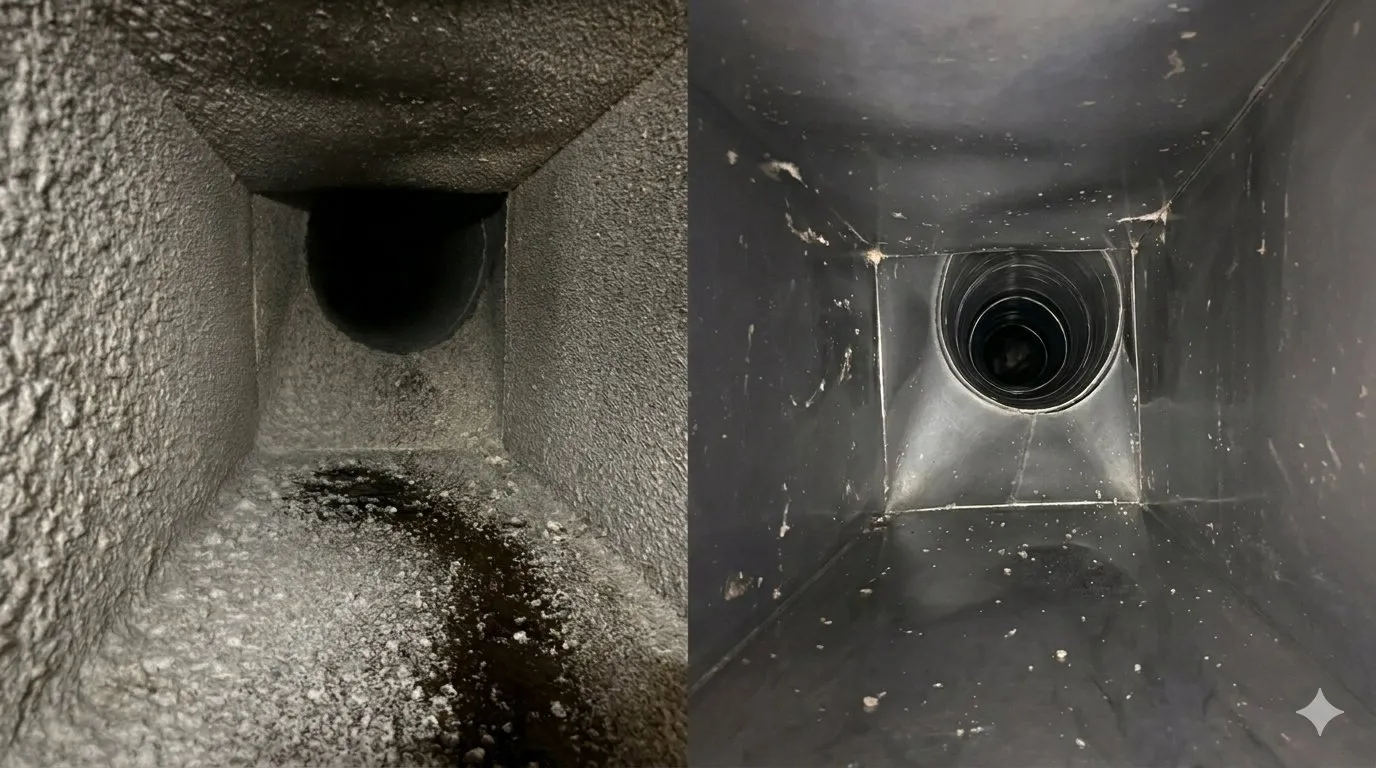
You get before and after photos of the impeller and housing. It notes what was done and anything that couldn’t be reached, along with the recommended next clean date.
A change in how the fan sounds is worth noting. New noise or vibration often means grease is building on the impeller and early action can save a repair.