Duct Doctor · London and the South East
Kitchen extract ductwork cleaning
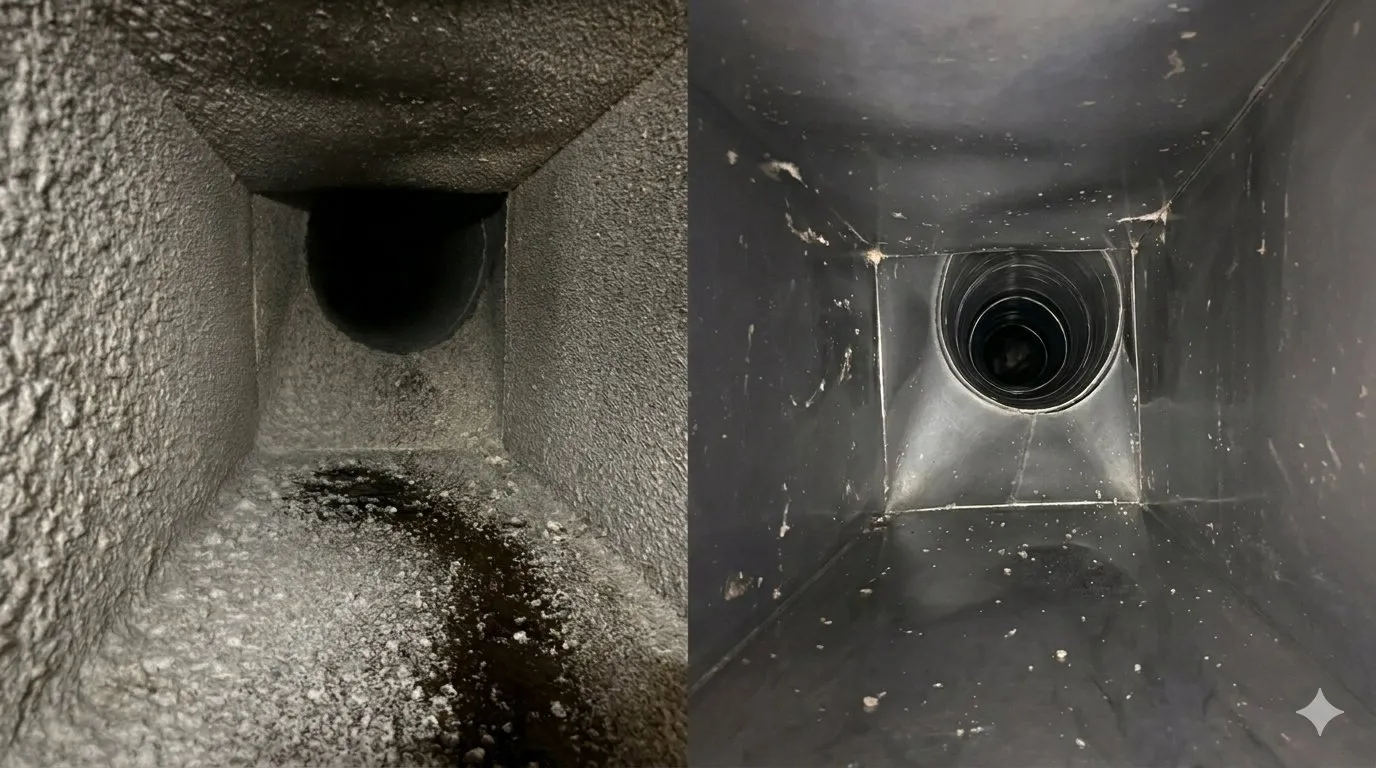
Kitchen extract ductwork cleaned along its full length, horizontal runs and vertical risers, through access panels, with grease readings before and after.
- Grease lining the inside of the duct
- Duct sections never cleaned because they can’t be reached
- Grease leaking from joints or access panels
What ductwork cleaning involves
Most of the grease in a kitchen extract ends up in the ductwork, out of sight above ceilings, inside risers and across roofs. As cooking vapour travels away from the canopy it cools, and the fat settles on the inside walls of the duct. Left alone, it builds into a thick, sticky layer that can carry a fire from the kitchen right through the building. We clean the duct along its full length through access panels, scraping out heavy deposits and degreasing the metal back to a clean surface. Bends, junctions and attenuators get the same attention as the straight runs, because grease collects wherever the air slows down. We take readings and photos at set points before and after. Any section we can’t reach is recorded on the report, and we can fit new panels so it can be cleaned next time. Our guide to duct access panels explains why they matter.
We cover London and the South East, and have done since 2009. We’re a BESCA Vent Hygiene Elite member, cleaning to BESA TR19® Grease, we hold CHAS, SafeContractor and ISO 9001, and we’re fully insured.
Problems we put right
- Grease lining the inside of the duct
- Duct sections never cleaned because they can’t be reached
- Grease leaking from joints or access panels
- Smells travelling through the building
- An old report with large uncleaned sections
What we work on
- Horizontal duct runs
- Vertical risers
- Bends and junctions
- Attenuators
- Access panels
- Multi-storey ducts

How it works
- We trace the duct route from the canopy to the fan and find every access panel.
- We take grease readings and photos at set points along the duct before we start.
- Heavy deposits are scraped out by hand and the duct is degreased through each access panel.
- Risers, bends, junctions and attenuators are cleaned along with the horizontal runs.
- We take readings and photos again and record any sections we couldn’t reach on your report.
Access panels decide what gets cleaned
A duct can only be cleaned where it can be reached. Older systems, and some newer ones, don’t have enough access panels, so long sections are never cleaned and the grease in them grows year after year. TR19 expects those sections to be recorded on the report, not skipped quietly. We can fit new access panels where they’re needed, so the next clean covers the whole route.
Risers and multi-storey buildings
In hotels, blocks with restaurants on the ground floor and other tall buildings, the extract duct often rises through several floors to the roof. Risers need careful planning: access on each floor, protection for the rooms around them and safe working at the top. We plan the route at the survey stage so the clean runs smoothly on the night.
Why grease readings matter
BESA guidance says grease should not exceed a mean of 200 microns between cleans, and 500 microns or more at any point needs immediate spot cleaning. Readings are taken by Wet Film Thickness Test (WFTT) or Deposit Thickness Test (DTT). Readings before and after a clean show how fast your duct is fouling and help set the right interval for your kitchen.
Why it’s worth doing now
The duct is where grease builds up unseen and where a kitchen fire can travel. A fire drawn into a greasy duct can move through the building faster than anyone can reach it. Many insurers ask for evidence that the whole system has been cleaned, not just the canopy. Ducts that haven’t been cleaned for years are slower and harder to clean the longer they’re left. Getting the duct surveyed and cleaned now also shows you where access panels are missing, so the gaps can be closed.
What affects the quote
We don’t publish set prices, because no two systems are the same. Send us a few details and photos, or book a survey, and we’ll give you a fixed price before any work starts. The main things that change it are:
- The size of the system: number of canopies, length of ductwork, risers and fans
- How much grease or dirt has built up since the last clean
- Access: roof-level fans, ceiling voids, risers and how many access panels there are
- When the work can happen: overnight, weekends or school holidays
- Whether extras are needed, such as new access panels, filter exchange or damper testing
- How many sites you want covered on one schedule
What a good quote includes
- A survey or clear photos before the price is given
- Exactly which parts of the system will be cleaned or tested
- How areas that can't be reached will be recorded
- A certificate or written report with before-and-after photos
- Proof of insurance and accreditations you can check
- The recommended date for the next visit
Afterwards
Your photo report shows each access point before and after, with grease readings and any sections we couldn’t reach. If we’ve recommended extra access panels, plan them before the next clean so the whole route can be covered. Keep the filters clean between visits, as they stop much of the grease reaching the duct. We’ll recommend the next clean date based on your readings.
Kitchen extract ductwork cleaning: common questions
How do you clean inside the duct?
Through access panels along its length. Heavy grease is scraped out by hand, then the duct is degreased with methods suited to the deposit, such as degreasers, hot water or steam.
What if there aren’t enough access panels?
Any section we can’t reach is recorded on the report. We can fit new access panels so the whole duct can be cleaned on the next visit.
Can you clean ducts that run through other parts of the building?
Yes. We plan access with you at the survey, protect the areas around each panel and work when those spaces are quiet.
Will the clean make a mess in the rest of the building?
We protect the areas around each access point with sheeting and contain the waste grease and water so it can be taken away.
Do you clean ducts that serve more than one kitchen?
Yes. Shared ducts need planning with everyone who uses them. Tell us about the layout and we’ll plan the clean and the access with you.
Do you give a fixed price before you start?
Yes. Send a few details and photos, or book a survey, and we’ll give you a fixed quote, usually within one working day.
Do you work out of hours?
Yes. We work evenings, overnight and at weekends so your kitchen or building doesn’t lose a day, and there’s a 24/7 line for emergencies.
Page updated 30 October 2026
Near you
We cover London and the South East. Find ductwork cleaning in your town:
- London
- Brighton
- Southampton
- Portsmouth
- Reading
- Oxford
- Milton Keynes
- Guildford
- Chelmsford
- Maidstone
- Woking
- Crawley
- Croydon
- St Albans
- Canterbury
- Basingstoke
- Slough
- High Wycombe