Duct Doctor · London and the South East
Laundry and tumble dryer extract cleaning
Lint and fluff cleared from commercial tumble dryer and laundry extract ducts, so dryers run properly and a build-up of flammable dust isn’t left in the duct.
- Lint building up in the extract duct
- Dryers taking longer to dry
- Hot, stuffy laundry rooms
Laundry and tumble dryer extract cleaning: call for a fixed quote
Why laundry extracts need cleaning
Every load in a tumble dryer sheds fibres. Dryer filters catch much of it, but fine lint and fluff get past and are blown into the extract duct, where they settle along the bottom, in bends and around the fan. Over time it builds into a thick, dry layer.
Lint is fine and dry, and it catches fire easily. A dryer runs hot, so a duct lined with fluff is a fire risk. A blocked duct also slows the airflow: dryers take longer, use more energy and run hotter, and the laundry room gets hot and humid. Our article on laundry extract fire risk explains more.
Lint doesn’t only collect in the duct. It builds up inside the dryer’s own exhaust connection, behind the machines and around the extract fan, where it is easy to forget. A laundry that runs from early morning to late evening can fill these spaces faster than people expect. A clean duct also means the dryers can work as their makers intended, rather than running longer and hotter to do the same job.
Where we work
- Hotels with on-site laundries
- Care homes and hospitals, where dryers run for long hours every day
- Commercial and contract laundries
- Launderettes
- Leisure centres, gyms and spas with towel laundries
- Schools and colleges with boarding or sports laundries
What a laundry extract clean covers
- We trace the extract route from each dryer to the outside, including any shared ducts and fans.
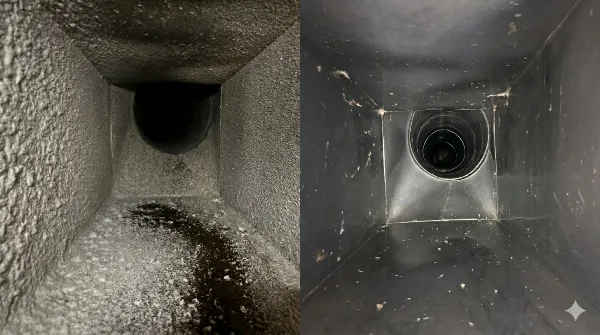
- We photograph the inside of the duct at access points before we start.
- Lint and fluff are removed from the dryer connections, ductwork, bends and risers through access points.
- Any extract fan is isolated and cleaned, and the discharge is cleared.
- We photograph the results and give you a report, including any sections that couldn’t be reached.
Where there aren’t enough access points to reach the whole duct, we can fit access panels so the full route can be cleaned.
Many laundry ducts are long, narrow or run through ceiling voids and walls, and some are shared by several dryers. We trace the whole route at the survey, so the clean covers every branch rather than just the parts close to the machines.
How often
There is no single interval that suits every laundry. It depends on how many dryers there are, how many hours they run, what is being dried and how well filters are looked after. A busy care home or hotel laundry running all day fills its ducts much faster than a small laundry used a few times a week. We look at the duct, recommend a sensible interval and adjust it once we see how quickly lint builds up. A maintenance contract can keep it on schedule.
Records of each clean help you show the duct is looked after.
Your part between cleans
- Clean dryer lint filters as often as the maker recommends, usually after every load or every shift.
- Check filters are fitted properly and not damaged.
- Keep the area around dryers clear of loose fluff and stored items.
- Tell us if drying times get longer or the room gets hotter. Both can mean the duct is getting blocked.
Working around your laundry
Dryers need to be off and cool before we start. We work early, late, overnight or at weekends, and can clean one dryer line at a time so the laundry keeps running. We protect the area and take the lint and debris away with us.
In care homes and hospitals, laundries often run every day. Tell us about the busiest times and any infection control rules we need to follow, and we’ll plan the work so clean linen keeps coming. In hotels, we can work around changeover times and housekeeping schedules.
What it costs
We don’t publish prices. The cost depends on how many dryers there are, the length and route of the ducts, access and how much lint has built up. Send us a few photos and details and we’ll give you a fixed quote, usually within one working day.
If you also have a kitchen extract that needs cleaning, we can plan both on the same visit, with one quote that sets out each part of the work.
Near you
- London
- Brighton
- Southampton
- Portsmouth
- Reading
- Oxford
- Milton Keynes
- Guildford
- Chelmsford
- Maidstone
- Woking
- Crawley
Related
Laundry and tumble dryer extract cleaning: common questions
Why does lint in a dryer duct matter?
Lint is fine, dry and catches fire easily, and dryers run hot. A blocked duct also makes dryers slower and hotter.
Isn’t cleaning the dryer filter enough?
Filters catch much of the lint, but fine fluff still gets into the duct. Over time it builds up where daily cleaning can’t reach.
How often should a laundry extract be cleaned?
It depends on how many dryers you run and for how long. We’ll recommend an interval and adjust it as we see how quickly lint builds up.
Can you clean while the laundry is working?
We clean one dryer line at a time where possible, so the rest of the laundry keeps going. The dryers we work on must be off and cool.
Do you give a report?
Yes. You get photos before and after and a note of any sections we couldn’t reach.
Page updated 30 October 2026