Duct Doctor · London and the South East
Duct access panel installation
New access panels fitted to kitchen extract and ventilation ductwork, so the sections nobody could reach can finally be cleaned, inspected and recorded.
- Duct sections never cleaned
- Uncleaned areas on your TR19 report
- Dampers that can’t be tested
Why access panels matter
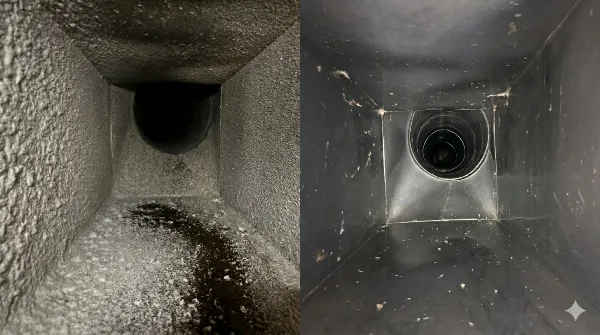
A duct can only be cleaned where it can be reached. Many kitchen extract systems were installed with too few access panels, or panels in the wrong places, so long runs, bends and risers have never been cleaned. Grease keeps building up in those sections year after year, out of sight.
Under TR19® Grease, any part of the system that couldn’t be cleaned has to be recorded on the report. That’s honest, but it also means your certificate doesn’t cover the whole system, and many insurers want to see the full extract cleaned. Fitting access panels closes the gap so the next clean covers the whole route.
It also matters for the fire risk. The sections that can’t be reached are usually the ones with the most grease, because they have never been cleaned at all. A fire drawn into the duct doesn’t stop at the last access panel. Closing those gaps is one of the most effective improvements you can make to an older extract system.
Finding where panels are needed
We trace the duct from the canopy to the fan, note every existing panel and mark the sections that can’t be reached. Bends, junctions, risers, attenuators and the sections either side of a fan are the usual problem areas, because grease collects wherever the air slows or changes direction. If you have a previous TR19 report listing inaccessible areas, send it to us. It’s the quickest way to see where panels are needed.
A pre-clean survey is a good time to plan panels, so they can be fitted before or during the first clean.
We also look at what’s around each possible position: ceiling grids, pipes, cables, sprinkler heads, lights and structure. A panel squeezed into a spot nobody can open is no use. Where the obvious position is blocked, we look for the next best one and explain the choice.
How we fit them
- We agree the positions with you, checking that each one can be reached safely and isn’t blocked by services, ceilings or structure.
- The duct is cleaned around the opening first, so we aren’t cutting into heavy grease.
- An opening is cut to suit the panel and the duct.
- A grease-tight access panel suited to kitchen extract ductwork is fitted, so it can be opened and closed again at every clean.
- Each panel is labelled and recorded, with its position marked on the report so it’s easy to find next time.
Panels for fire dampers
Fire dampers need access too. BESA’s guidance is that fire dampers should be tested at least annually, and a damper you can’t reach can’t be tested or maintained (BESA: fire damper testing requirements). Where a damper has no access, we can fit a panel in the duct next to it and tell you where ceiling access is also needed. See fire damper testing.
Ceilings, risers and other trades
Ducts often run above suspended ceilings, inside boxed-in risers or behind plasterboard. A panel in the duct is only useful if the ceiling or boxing around it can be opened too. We’ll point out where a ceiling hatch or removable section is needed, and work with your builder or facilities team where other trades are involved. Our article on duct access panels has more on planning access.
When the work is done
We usually fit panels out of hours, alongside a clean where possible, so the kitchen loses only one evening or night. Once they’re in, the sections that were listed as inaccessible can be cleaned and photographed, and your next TR19 certificate and photo report can cover more of the system.
We give you a simple record of every panel we fit, with its position, so your facilities team and any future contractor can find them. If you change contractor later, that record saves time and makes sure nothing is missed.
What it costs
We don’t publish prices. It depends on how many panels are needed, the duct size and material, how easy each position is to reach, and whether ceilings or boxing have to be opened. We’ll give you a fixed quote, usually within one working day.
Where panels are fitted alongside a clean, we set both out on one quote, so you can see what each part covers.
Near you
- London
- Brighton
- Southampton
- Portsmouth
- Reading
- Oxford
- Milton Keynes
- Guildford
- Chelmsford
- Maidstone
- Woking
- Crawley
Related
Duct access panel installation: common questions
How do I know if I need more access panels?
Look at your last TR19 report. If it lists sections that couldn’t be cleaned, more panels are probably needed. A survey will confirm where.
Can panels be fitted to any duct?
Most ductwork can take an access panel, but each position has to be reachable and clear of services and structure. We check before we fit.
Will fitting panels mean closing the kitchen?
Only for the time we’re working. We usually fit panels out of hours, often alongside a clean.
Do you fit access panels for fire dampers?
Yes. A damper that can’t be reached can’t be tested. We can fit a panel in the duct next to it and tell you where ceiling access is needed.
Will the new panels leak grease?
We fit grease-tight panels suited to kitchen extract ductwork, so they can be opened at each clean and closed again properly.
Page updated 30 October 2026