Duct Doctor · London and the South East
Extract and ventilation cleaning for hospitals and care homes
Strict hygiene and access control. Kitchen extract, ventilation and laundry extract cleaned to TR19® in buildings that never close, planned with your infection control and estates teams.
- Planned with infection control
- Kitchen, laundry and ventilation
- TR19® certificate and photo report
Extract and ventilation cleaning for hospitals and care homes: call for a fixed quote
Strict hygiene and access control
Hospitals and care homes are open every hour of every day, and the people in them are often vulnerable. Extract and duct cleaning there is planned with more care than almost anywhere else. Before we start, we agree the method with your estates, facilities and infection prevention and control teams: which areas we can use, how dust, grease and water are contained, how we keep routes clear, and when the work can happen.
We follow your sign-in and access rules, wear the identification you ask for, stay in the areas agreed and work with the staff member who escorts us where that is needed. Work areas are sheeted and closed off, and every bit of waste is bagged and removed.
What hospitals and care homes need
- Kitchen extract cleaning for main kitchens, ward kitchens and staff restaurants
- Laundry and tumble-dryer extract cleaning, where lint can build up into a fire risk
- TR19® Air cleaning of supply and extract ductwork
- Air handling unit cleaning: filters, coils, drain trays and fans
- Fire damper and smoke damper testing, with remedials
- Kitchen deep cleaning and grease trap cleaning
See our guide to laundry extract fire risk for why care home laundries need regular cleaning.
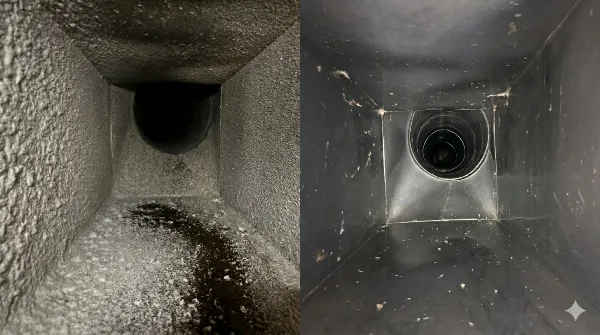
Ventilation matters here as much as the kitchen. Supply and extract ductwork and air handling units collect dust and debris, filters clog and water can stand in AHU drain trays. BESA’s ventilation hygiene guidance takes a risk-based approach under TR19® Air: inspect, measure and clean where needed. We photograph what we find, so your estates team can see the condition of each system.
How a clean runs on site
- We survey the system and agree a method statement and risk assessment with your estates and infection control teams.
- We confirm the date, the time window, access routes and who will meet us.
- On arrival we sign in, set up barriers and sheeting, and photograph the system before we start.
- We clean the agreed sections, containing grease, dust and water as we go.
- We take readings and photos after the clean, check fans run and filters are refitted, and clean our work area.
- All waste is bagged and removed from site.
- You receive the TR19® certificate and photo report for your records.
Cooking hours and cleaning frequency
A hospital or care home kitchen often cooks breakfast, lunch and supper every day of the year. BESA’s kitchen extract guidance sets these minimums:
| Cooking hours a day | BESA use band | Minimum cleaning interval |
|---|---|---|
| 12–16 hours | Heavy | Every 3 months |
| 6–12 hours | Moderate | Every 6 months |
| 2–6 hours | Light | Every 12 months |
A large hospital kitchen may sit in the heavy band, while a small care home kitchen cooking for a few hours a day is often moderate. Grease readings at set points show whether the real interval should be shorter. BESA says grease should not exceed a mean of 200 microns between cleans, and 500 microns or more at any point needs immediate spot cleaning.
Scheduling around care
Kitchens in care settings can’t simply close for a day. We clean between the evening meal and breakfast prep, or plan the work so the kitchen keeps running while one section at a time is cleaned. Ventilation and AHU work is phased so that wards, bedrooms and corridors aren’t without air for longer than agreed, and noisy work avoids quiet hours. We keep you informed throughout, and our 24/7 emergency line is there if an extract or laundry fan fails.
In a care home, residents may be unsettled by unfamiliar people and noise. We keep to the times and routes agreed with the manager, keep doors to work areas closed and avoid mealtimes and medication rounds in shared spaces. In hospitals, we work to the permits and controls your estates team uses, and stop if a ward or department asks us to.
Fire safety: the responsible person
People in hospitals and care homes may need help to leave in a fire, which makes keeping fire risk low all the more important. The Regulatory Reform (Fire Safety) Order 2005 puts that duty on the responsible person, usually the trust, the provider or the owner. It covers grease in kitchen extracts, lint in laundry ducts and fire dampers that must close when needed. BESA says all fire dampers should be tested at least annually; see its fire damper testing guidance. GOV.UK explains the responsible person’s duties.
TR19® is not law, but it is the benchmark insurers, fire officers and EHOs look to. Many insurers ask for proof of regular cleaning, and may refuse or reduce a claim without it. Care homes are also inspected by the Care Quality Commission, so clear maintenance records help whoever is asking.
EHOs, ratings and your records
Hospital and care home kitchens are inspected by the council’s environmental health team, and ratings are published on the Food Standards Agency’s food hygiene ratings site. After every clean we issue a TR19® certificate through the BESCA VHE portal and a photo report with before and after pictures, the grease readings, any areas not reached and the next clean date. Keep them in your maintenance log, ready for an inspector, insurer or fire risk assessor. We are a BESCA Vent Hygiene Elite member, cleaning to BESA TR19® Grease, with CHAS, SafeContractor and ISO 9001.
Care groups and multi-site estates
Care groups and healthcare estates can put every kitchen, laundry and ventilation system on one maintenance contract. Each home or building has its own frequency, certificates and reports, so you can see the whole estate at a glance.
We cover London and the South East. Before the first round of cleans, we survey each site, list the systems, damper locations and access points, and flag any sections that can’t be reached. That gives you one clear picture of the estate and a programme that spreads the work through the year, rather than leaving every home to arrange its own cleaning. New homes can be added as your group grows.
Near you
- London
- Brighton
- Southampton
- Portsmouth
- Reading
- Oxford
- Milton Keynes
- Guildford
- Chelmsford
- Maidstone
- Woking
- Crawley
Related
Extract and ventilation cleaning for hospitals and care homes: common questions
How do you work around infection control?
We agree the method with your infection prevention and control and estates teams first: work areas, containment, timing and waste removal.
Can you clean without closing the kitchen?
Yes. We clean between the evening meal and breakfast prep, or in sections, so meals keep coming.
Do you clean care home laundry extract?
Yes. Laundry and tumble-dryer extract collects lint, which is a fire risk, so we clean it alongside the kitchen system.
Do you test fire and smoke dampers?
Yes. BESA says fire dampers should be tested at least annually. We drop test fire dampers, test smoke dampers and carry out remedials.
Who is the responsible person in a care home?
Usually the care provider or owner. They must assess and reduce fire risk under the Fire Safety Order 2005.
What records will we get?
A TR19 certificate and a photo report for every system, with readings, any areas not reached and the next clean date.
Page updated 30 October 2026