Greater London · Kitchen extract cleaning
TR19 kitchen extract cleaning in Canary Wharf
Specialist kitchen extract cleaning for Canary Wharf: diagnosis first, then a fixed quote, the work and a report with pictures. Ask us for a fixed quote.
- Stale cooking odours from the system
- An extract that no longer clears the smoke
- Grease dripping from the canopy or filters
Kitchen extract cleaning for kitchens and businesses in Canary Wharf
A kitchen extract system is far more than the canopy you can see. Behind it sit the plenum and grease filters, then the ductwork, risers, extract fan and discharge, and grease settles in every one of them. Our clean follows the air from canopy to discharge, cleaning to BESA TR19® Grease. The work covers horizontal duct runs, extract fans and vertical risers, and common reasons people get in touch are a kitchen taken over without any extract records and heavy grease build-up inside the duct runs. For TR19 kitchen extract cleaning in Canary Wharf, you get one team and one number for every site, wherever you are in Greater London.
What can be cleaned depends on what can be reached. Sections without access panels are recorded on the report, and new panels can be fitted so they’re cleaned next time.
London kitchens tend to trade late and open early, so work in Canary Wharf is normally booked for the night or the early hours. Parking, loading and access to the roof are agreed with the building before the night of the clean.
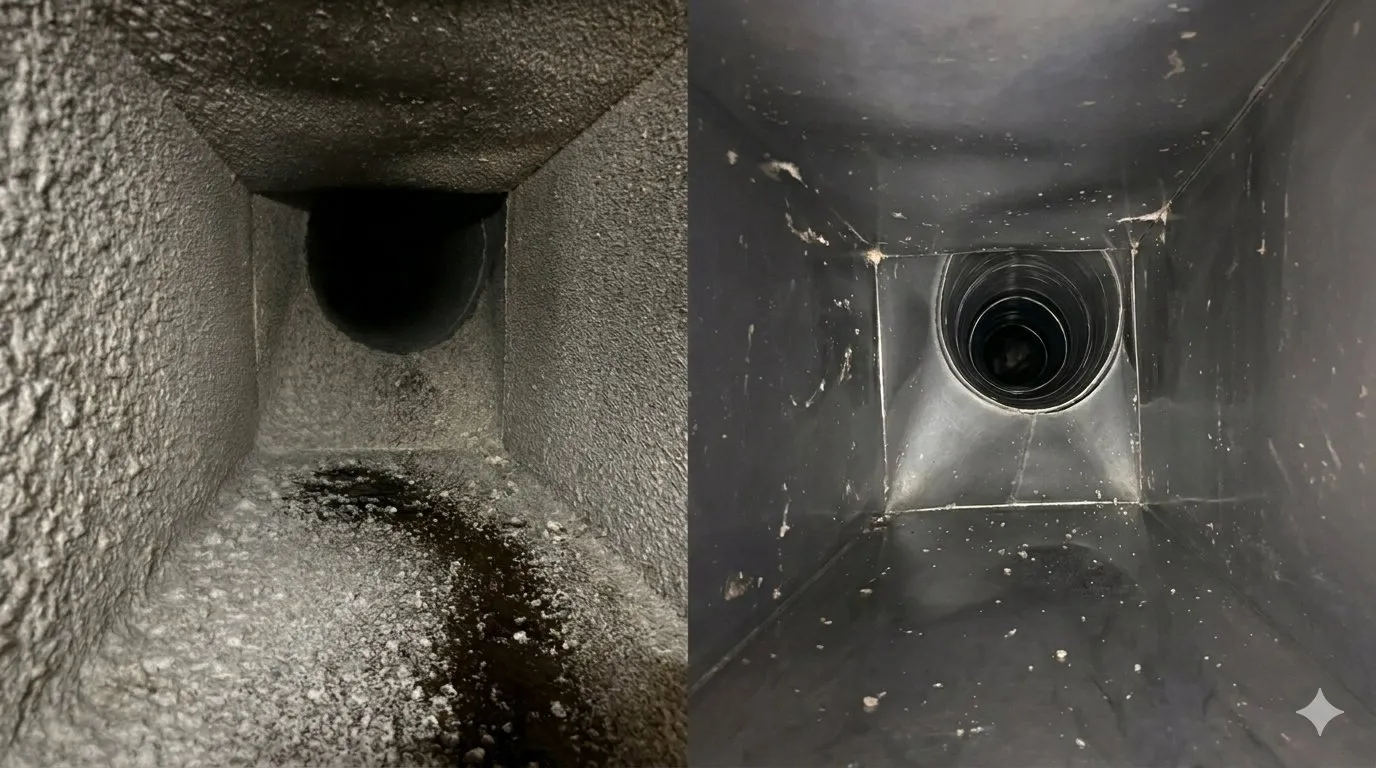
The sign-off is always in writing: a dated report with photos of the work, and for TR19® Grease cleans, a certificate issued through the BESCA VHE portal. It shows what was done and what, if anything, couldn’t be reached.
- Where
- Canary Wharf (E14, SE16, E22)
- Wider area
- Greater London
- Reporting
- Certificate plus before-and-after photos
- Quotes
- A fixed price before we start
- Working hours
- Overnight and weekend work, 24/7 emergency callout
- Phone
- 0345 646 2711
- Checked
- 30 October 2026
Staff cleaning versus specialist work
Some jobs should never be done in-house: opening up ductwork, cleaning fans, drop testing fire dampers and measuring grease need training, the right equipment and safe access. That’s our job.
When your team notices a problem between visits, such as dripping grease, a noisy fan, a smell or a filter that won’t come clean, it’s best reported rather than tackled in-house. We’ll take a look and send you a fixed quote.
When something else is needed
To be straight with you, some problems need a different fix:
- Faulty fire dampers in the duct
- An undersized canopy or fan
- Blocked drains from a neglected grease trap (a separate service)
If you’re not sure, just ring 0345 646 2711, or send details by email and we’ll give you a straight answer before booking.
Where we work
- Extract fans
- Horizontal duct runs
- Vertical risers
- Discharge points
- Canopies and hoods
- Plenums and filters
Why act early in Canary Wharf
TR19® isn’t law, but the Regulatory Reform (Fire Safety) Order 2005 is. It puts a duty on the responsible person to assess and reduce fire risk, which in a kitchen includes the grease in the extract. Cleaning to TR19 is the recognised way to show you’ve done it. Every month a London system goes without attention adds to what has to be done later.
Every site is different, so each one gets its own fixed quote. The size of the job, how we reach it, its condition and the working hours all make a difference.
Why Canary Wharf businesses choose us
- Accredited under CHAS and SafeContractor, with ISO 9001
- Out-of-hours work and a 24/7 emergency line
- We are fully insured
- A fixed price before any work starts
Take a look at how cleaning jobs are priced and our accreditations and certificates.
How the job changes from site to site
Canopy and plenum
The canopy catches the vapour, and the plenum behind the filters is where it first condenses. We clean both inside and out, with the filter housing cleaned too.
Restaurant and pub kitchens
Restaurants and pubs tend to cook long hours with plenty of frying and grilling, so their cleaning interval is often 3 or 6 months under BESA guidance. Cleans are done after close, overnight or before opening.
Canary Wharf: your questions answered
Do you clean school canteen extracts around Canary Wharf out of term?
Yes, out-of-term visits are normal for schools. There are about 56 schools, colleges and universities on the FSA’s food hygiene register within about 1.5 miles of Canary Wharf. Tell us your holiday dates and we will book the visit for when the site is empty.
Which council inspects kitchens in Canary Wharf?
In Canary Wharf, it’s Tower Hamlets council that carries out food hygiene inspections. It helps to keep the extract cleaning records with your food safety paperwork, so they’re ready if asked for.
Can you quote from pictures?
Yes, where the pictures show enough. If not, a site survey comes first, and the quote follows that.
Can you set up regular visits?
Yes. Regular plans can run on 3, 6 or 12-monthly cycles, to suit the system and how it’s used.
What should I send you?
Only a few details: where it is, what kind of site, when it’s open and the access. Photos and any previous paperwork make it quicker. After that, simply give us a ring on 0345 646 2711 or email us.
Do you cover Canary Wharf?
Yes. Our technicians work in Canary Wharf, as part of our area across London and the South East.
What paperwork comes with a kitchen extract clean?
Yes, a TR19 certificate, along with a photo report. The report lists what was cleaned, anything we couldn’t reach and when the next clean is due.
Will my insurer ask for a TR19 certificate?
Extract grease is fuel for a kitchen fire, which is why many insurers require TR19 cleaning. Our certificate and photo report give you that evidence.
What affects the cost of kitchen extract cleaning
Your quote is based on your site. We consider:
- The times the site is available
- Access, including roofs, risers and ceiling voids
- Any permits to work or inductions
- How big the system is
What you pay reflects the actual work. That is why we survey first, from pictures or on site, and the price is agreed before any work starts.
Asking for a quote
There’s no need for technical detail. It helps if you can send:
- When the site is open and when it’s quiet
- Your last certificate, test record or report
- A few general shots of the system
- Any access panels or hatches you can see
Getting a quote doesn’t take long. Call or email with a few details and you’ll usually have a fixed price within one working day. Where a survey is needed, we arrange a time that suits the site.
What we are called out for in Canary Wharf
Grease in the extract matters because it burns. A flare-up on the range can be drawn up into the canopy and duct, and once grease in the duct catches, fire can spread through the building’s ductwork. For a kitchen in Canary Wharf, keeping that fuel under control is part of the fire risk assessment.
What we’re most often called out for:
- A system with no record of a TR19 clean
- Cleaning needed before an insurance renewal or survey
- A new tenancy or takeover with no cleaning history
- Fat running down the canopy edge
If you run catering at a healthcare site, such as a hospital like Poplar Hospital about 0.7 miles north-east, the extract may need cleaning more often than a part-time kitchen.
Questions to ask before you book
- Whether a written report and pictures are included
- What happens if part of the system cannot be accessed
- Proof of insurance
- If the quote is a fixed price or an estimate
Towns and villages near Canary Wharf
Other services in Canary Wharf
Canary Wharf kitchens: local notes
Food Standards Agency records list about 453 restaurants, cafés and canteens and about 141 takeaways in and around Canary Wharf, up to about a mile and a half out. Any of them cooking under a canopy is sending grease into its ductwork every service. London Fire Brigade covers Canary Wharf. Fire and rescue authorities enforce the Fire Safety Order in most non-domestic premises, and in a kitchen that fire risk includes the grease in the extract. Environmental health officers from Tower Hamlets council inspect food businesses in Canary Wharf. A greasy canopy or dripping filters are the sort of thing an inspection can pick up. Our report lists what was cleaned and when, which is useful to have ready.
Where a hall near St Peter's Church, or anywhere in Canary Wharf, hosts lunch clubs or events, its extract gathers grease just as a café’s does. For schools such as Our Lady and St Joseph Catholic Primary School, kitchen extract cleaning is typically booked for the holidays, when the canteen is closed.
Canary Wharf is about 2 miles north-west of Greenwich, in Greater London. Whether your site is in the middle of Canary Wharf or further out, kitchen extract cleaning is available to all kinds of commercial premises, from small sites to large estates. Across Greater London, we cover 764 places, Canary Wharf among them.
Here we cover the E14, SE16 and E22 postcode area for kitchen extract cleaning. Whether your site is on Castor Lane, Cassilis Road and Dockyard Lane or a nearby road, our technicians can take on the work. Being close to the A1261, Canary Wharf is simple for us to get to for kitchen extract cleaning. If your site is just outside Canary Wharf, we cover London Docklands (1 mile east), Poplar (1 mile north-east), Heron Quays (1 mile south-west), Coldharbour (1 mile east) and Blackwall (1 mile east). We also work in nearby towns such as London (3 miles west), City of Westminster (6 miles west), Marylebone (6 miles west), Kensington (8 miles west), St Pancras (4 miles west) and Shoreditch (3 miles north-west).
Around Canary Wharf
In Canary Wharf, that means kitchens and buildings near Tower Hamlets College, Sir John McDougall Gardens and The Ledger Building pub and the streets around them. Canary Wharf has its own railway station: Canary Wharf station. Nearby you will also find The Pumphouse Educational Museum (0.8 miles west) and Surrey Quays Shopping Centre (1.4 miles south-west). The countryside around Canary Wharf includes St. James's Park Lake and Tower Hill.
What we do, step by step
The visit has three parts: getting the area ready, doing the work and signing it off. Set-up means sheeting and making equipment safe, while signing off means the written report and pictures. Most of the time goes on the work itself, and that takes a few hours for a small kitchen, longer for a large system. Loading bays, visitor permits and roof access are the first things we ask about for a site in Canary Wharf.
- You send photos or we visit, and the system is surveyed from canopy to discharge.
- We take grease readings at set points and send you a fixed quote.
- On the night, the equipment is off and cool and the kitchen is sheeted.
- Filters, canopy and plenum are cleaned, then the ducts, risers, fan and discharge.
- Readings are repeated, photos taken, and your TR19 certificate and photo report issued.
Before we arrive
- Agree a time when the area can be out of use
- Make sure someone can let us in and lock up afterwards
- Dig out any earlier paperwork for the system
How to get a quote
The quickest way to a quote is to send photos: wide shots of the system, close-ups of anything that worries you and how we’d get to it. Add the site type and your opening hours, and many jobs can be priced from that alone.