Greater London · Extract fan cleaning
Extract Fan Cleaning in Isle of Dogs
Specialist extract fan cleaning for Isle of Dogs: diagnosis first, then a fixed quote, the work and a report with photos. Ask us for a fixed quote.
- A motor area thick with grease
- A heavily greased fan housing
- Burning smells from the fan area
Honest limits
A few issues sit outside what this work can do:
- Grease in the duct and canopy before the fan (those need a full TR19 clean)
- A faulty speed controller or isolator
- An undersized fan that cannot cope
If in doubt, give us a ring on 0345 646 2711, or send details by email and we’ll say what we think before you book.
What we work on in Isle of Dogs
- Axial fans
- Roof-mounted fans
- Fan housings
- In-line fans
- Centrifugal fans
- Discharge points
How we handle extract fan cleaning in Isle of Dogs
The fan is cleaned as part of every full TR19® Grease clean, but some fans need cleaning between full cleans, especially when it has started to vibrate or sound rough. A fan-only clean is recorded as exactly that. If you have fat spreading onto the roof or wall by the fan and weak extraction at the canopy, we can put it right.
London kitchens are often tucked into basements or the back of a building, and the duct may run up through several floors before it discharges at the roof. In Isle of Dogs, as elsewhere in the capital, a long duct run means more access points to open and more grease to remove.
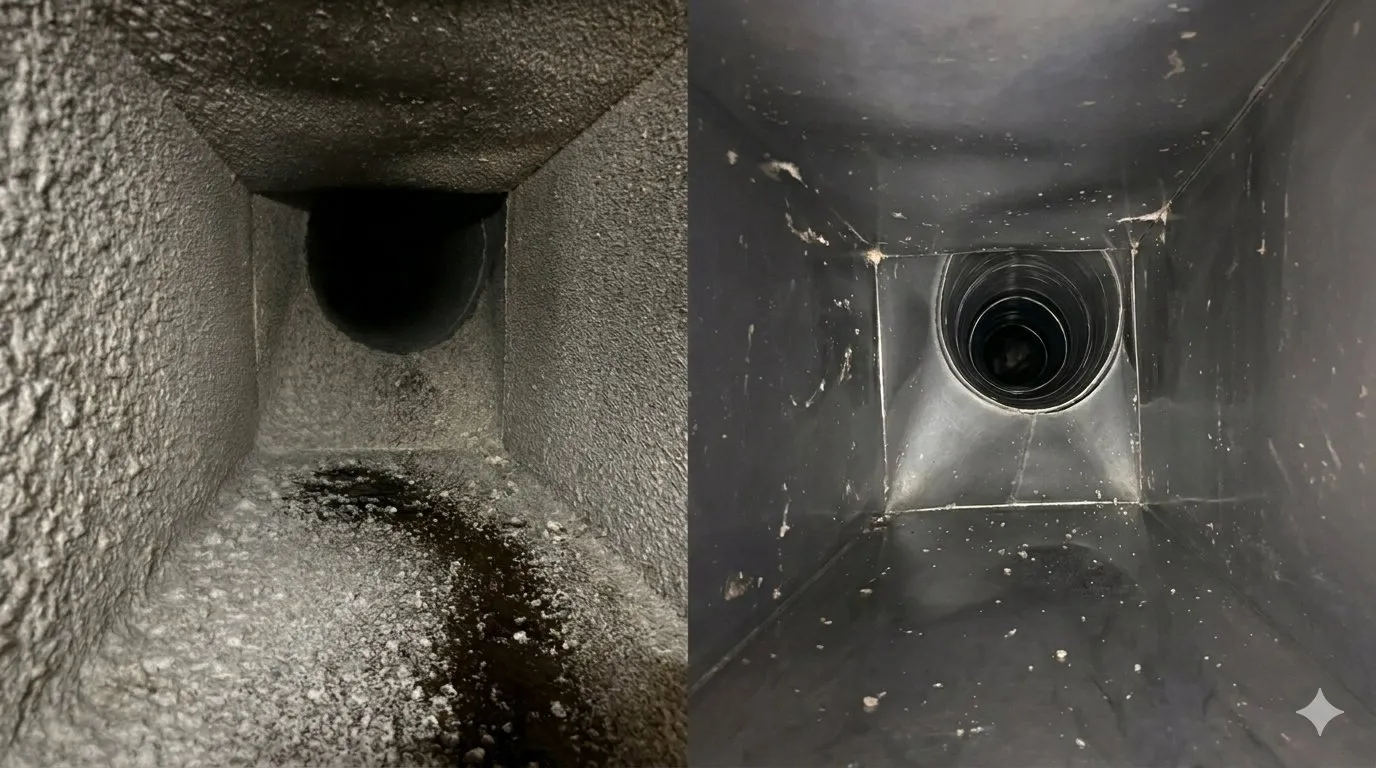
The sign-off is always in writing: a dated report with pictures of the work, and for TR19® Grease cleans, a certificate issued through the BESCA VHE portal. It shows what was done and what, if anything, couldn’t be reached.
- Place
- Isle of Dogs (E14, SE8, SE10)
- Wider area
- Greater London
- Paperwork
- Certificate plus before-and-after photos
- Price
- Fixed quote, usually within a working day
- When we work
- Nights, weekends or holidays to suit you
- Call
- 0345 646 2711
- Checked
- 30 October 2026
Why it’s worth doing now in Isle of Dogs
A greasy fan has to work harder to move the same air. Less air is pulled from the kitchen, so heat and smoke linger, while the motor runs under more strain. In a London building, a problem in a duct, damper or fan rarely stays in one unit.
Several systems or sites on one quote can make for a more efficient booking. Tell us about everything you’d like looked at, and you’ll get one fixed quote.
What you get with us
- Trading since 2009
- Photo reports with every job
- Member of BESCA Vent Hygiene Elite, cleaning to BESA TR19® Grease
- Fixed quotes from a survey or photos
Read our cost guide and our accreditations and certificates.
The process
The visit has three parts: getting the area ready, doing the work and signing it off. Set-up means sheeting and making equipment safe, while signing off means the written report and photos. The middle part takes longest, which takes a couple of hours per fan, depending on its size and the build-up. Loading bays, visitor permits and roof access are the first things we ask about for a site in Isle of Dogs.
- We start by checking where the fan sits and how to isolate it.
- Power to the fan is isolated before anyone touches it.
- The impeller and the housing around it are scraped clean.
- Blades, housing and the area around the motor are degreased with care.
- We reassemble, run the fan and photograph the result.
Before we arrive
- Have your last certificate or report to hand
- Allow time for equipment near the work to be turned off and cool down
- Mention any parking or loading restrictions
Ask for a quote
Every quote begins with a look at the system, either from pictures and details you send or from a site visit. After that, you get a fixed price for the work, before work begins.
Read more
How we price extract fan cleaning
The quote reflects the site in front of us. We take into account:
- How many systems or sites are involved
- The times the site is available
- The condition of the system
- Site rules, permits and inductions
What you pay reflects the actual work. That is why we survey first, from pictures or on site, and the price is agreed before work begins.
Asking for a quote
Photos and a few facts are often enough to price the work. Send what you can of the following:
- Where the site is and what kind of site it is
- Detail shots of panels, filters and grilles
- Anything you’ve noticed, such as smells, noise, drips or poor airflow
- Your opening hours and when the area is out of use
Quotes are quick. Call or email with a few details and you’ll usually have a fixed price within one working day. Where a survey is needed, we arrange a time that suits the site.
Questions from Isle of Dogs
Is parking a problem for work in Isle of Dogs?
Tell us where a van can stop near your site in Isle of Dogs, and about any building rules on loading. If the building has a loading slot system, we’ll book into it.
Which fire authority looks after Isle of Dogs?
Fire safety enforcement in Isle of Dogs is handled by London Fire Brigade. A recent cleaning certificate and a note of the next clean date show that grease in the extract is being managed.
Do you repair extract fans as well as clean them?
Fan repair and replacement is part of what we do. If cleaning shows a worn motor, bearings or impeller, we will tell you and quote for the repair.
What happens to the waste?
It’s contained and taken away. Grease, debris and waste water are collected as the work goes on, so it doesn’t spread.
Who is the responsible person?
Under the Regulatory Reform (Fire Safety) Order 2005, it’s the responsible person: often the employer, owner or occupier. In shared or managed buildings, a landlord, facilities manager or managing agent can share the duty.
Do you look at the system first?
Yes. Photos often do the job, while bigger or harder-to-see systems are surveyed on site.
Is TR19 cleaning required by law?
No. TR19® itself isn’t law; it’s a BESA specification. The legal duty comes from the Regulatory Reform (Fire Safety) Order 2005: the responsible person must assess and reduce fire risk, and cleaning to TR19® is the recognised way to show grease is under control.
How much does extract fan cleaning cost in Isle of Dogs?
The cost depends on the size of the system, its condition, access and timing. Call for a fixed quote and we’ll usually reply within one working day.
Grease, kitchens and Isle of Dogs
The Food Standards Agency lists about 88 bars, pubs and nightclubs and about 16 hotels, B&Bs and guest houses as registered food businesses within 1.5 miles or so of the middle of Isle of Dogs. Wherever they cook, the canopy, duct and fan collect grease just as a restaurant’s do. In Isle of Dogs, food businesses are inspected by environmental health officers from Tower Hamlets council. The cleanliness of the kitchen and its equipment, extraction included, is part of what they check. A dated certificate in the maintenance file answers the question before it’s asked. The fire and rescue service for Isle of Dogs is London Fire Brigade. The Fire Safety Order puts the duty on whoever runs a kitchen to control its fire risk, and a greasy duct is fuel.
If you run a church or community hall kitchen, near Church of St Nicholas or elsewhere in Isle of Dogs, its extract still collects grease from every lunch and event. Commuter trade near Greenwich station can mean long cooking hours, and long hours put a kitchen into BESA’s more frequent cleaning bands. If you run catering at a healthcare site, such as a hospital like Miller General Hospital about 0.9 miles south, the extract may need cleaning more often than a part-time kitchen.
Isle of Dogs is about 1 mile north-west of Greenwich, in Greater London. Whether your site is in the middle of Isle of Dogs or further out, extract fan cleaning is available to all kinds of commercial premises, from small sites to large estates. Across Greater London, we cover 764 places, and Isle of Dogs is one of them.
Every address in E14, SE8 and SE10 is within our area for extract fan cleaning, from the main roads to the quietest streets. Streets in the area include Creek Road, Wynan Road and Undine Road, and we cover them all for extract fan cleaning. We also cover the places around Isle of Dogs: North Greenwich (1 mile north-west), Millwall (1 mile west), Cubitt Town (1 mile north-east), Deptford (1 mile south-west) and Greenwich (1 mile south-east). We also work in nearby towns such as London (3 miles west), City of Westminster (6 miles west), Marylebone (6 miles west), Kensington (8 miles west), St Pancras (5 miles north-west) and Shoreditch (4 miles north-west).
Near you in Isle of Dogs
In Isle of Dogs, that means kitchens and buildings near The Ferry House Public House, Laban Centre and St. Paul's and the streets around them. Nearby too are Mudchute Park and Farm (less than half a mile north-east) and Canary Wharf College 3 (under half a mile north). For rail, the closest station is Greenwich station, about 0.7 miles south. A little further out are Greenwich Castle (1 mile south-east) and Surrey Quays Shopping Centre (1.3 miles west). Not far away are Tower Hill and Sue Godfrey Nature Park.
Multi-site and managed buildings
Keeping records across a portfolio is half the battle. Every visit ends with a dated report and photos, so you can show an insurer or inspector what was done at each site.
Facilities teams in offices, schools and healthcare sites book us too in Isle of Dogs and across Greater London. Work can be phased by floor, building or site to keep disruption down.
Towns and villages near Isle of Dogs
Also in Isle of Dogs
What the work involves, part by part
Inline duct fans
Inline fans sit within the duct run, often above a ceiling. We get to them through the duct or casing, once they’re isolated.
Fan housings and motors
Some fans use a belt drive. We clean around them and note any wear for your records.
In-house cleaning or a specialist?
Good housekeeping makes our visits easier, not unnecessary. Clean filters and tidy surfaces slow the build-up, but hidden parts of the system still need specialist attention.
Day-to-day cleaning is something your team can do: wiping down canopy surfaces, cleaning filters and keeping a simple log. Inside the ducts, risers and fan is specialist work, which is where we come in.