Duct Doctor · London and the South East
Ventilation and AHU cleaning for offices and retail
Ventilation and AHU cleaning to TR19® Air, plus kitchen extract cleaning for staff restaurants, cafés and food courts, done out of hours.
- TR19® Air ductwork and AHUs
- Staff restaurant and food court extract
- Fire and smoke damper testing
Ventilation and AHU cleaning for offices and retail: call for a fixed quote
Ventilation and AHU cleaning
Office buildings and shops depend on their ventilation. Supply ductwork brings in fresh air, extract takes stale air away, and air handling units filter, heat and cool it. Over time, dust and debris settle in the ducts, filters clog, coils get dirty and water can sit in drain trays. That affects how well the system works and how clean the air is.
BESA’s TR19® also covers these general supply and extract systems, under TR19® Air. The approach is risk-based: inspect the system, measure what is there and clean where it is needed. BESA’s ventilation hygiene guidance explains it, and notes that the Vent Hygiene Register expanded to cover TR19 Air from March 2026.
Certificates for ventilation cleaning should record the date, the location and the technician, and be kept in the building’s maintenance log.
What offices and shops need
- Ventilation duct cleaning of supply and extract systems
- Air handling unit cleaning: filters, coils, drain trays, fans and internal surfaces
- Fire damper drop testing, smoke damper testing and remedials
- Kitchen extract cleaning for staff restaurants, cafés and food court units
- Access panel installation where ductwork can’t be reached
- TR19 inspections and pre-clean surveys to plan the work
Inspection first, then cleaning
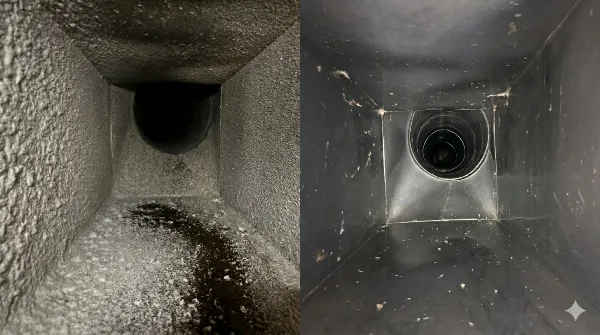
We start by looking at the system, from drawings and photos or on site. That tells us where the AHUs and access panels are, what the ducts are made of, and which parts need cleaning now and which can wait. You then get a fixed quote, usually within one working day. After the clean, post-clean verification and photos show the result, and the report records what was cleaned, any areas not reached and when the system should be looked at again.
Older buildings often have ductwork above ceilings with few or no access panels. Without panels, sections can’t be inspected or cleaned. We record them on the report, and can fit new panels so they can be reached next time. For fit-outs and refurbishments, it is worth thinking about access early, before ceilings go back up. See duct access panels explained.
Out-of-hours working
Most offices and shops don’t want ducts opened up while staff and customers are around. We work evenings, overnight and at weekends, so the work is done before the building opens. In multi-let buildings we agree access with the managing agent and keep to the areas and lifts they set. Floors are cleaned one at a time where that suits tenants better.
In shops, we can work after the doors close and be clear before staff arrive for the morning. Desks, stock and fittings under the work area are sheeted, ceiling tiles are lifted and replaced with care, and we clean up as we go. Plant rooms and roof plant are reached by the routes your building team agrees.
Why clean ventilation matters
Ventilation keeps a building comfortable and healthy to work and shop in. When dust builds up in ductwork and filters clog, airflow drops, fans work harder and rooms can feel stuffy. Debris in supply ducts can be blown back into occupied rooms. Dirty coils make heating and cooling less effective, and standing water in an AHU drain tray is a hygiene risk of its own.
Regular inspection shows where cleaning is needed, rather than cleaning everything on a fixed date. That is the thinking behind TR19® Air. Our guides to TR19® Air and AHU cleaning explain what to expect. Where we find damage, such as a failed damper, a collapsed flexible duct or a fan that is struggling, we tell you and include it in the report.
Staff restaurants, cafés and food courts
Where an office has a staff restaurant, or a shopping centre has a food court, the kitchen extract needs TR19® Grease cleaning. BESA’s kitchen extract guidance sets minimum intervals by daily cooking hours:
| Cooking hours a day | BESA use band | Minimum cleaning interval |
|---|---|---|
| 12–16 hours | Heavy | Every 3 months |
| 6–12 hours | Moderate | Every 6 months |
| 2–6 hours | Light | Every 12 months |
A staff restaurant serving breakfast and lunch on weekdays is often in the moderate band; a food court open all day may be heavy. A small tea point or pantry that only reheats food usually has no grease extract at all, but still has general ventilation. Grease readings set the real interval. In shared food courts, tenants’ ducts often join a common extract, so the landlord and each tenant need to know who cleans which part. See landlord and tenant responsibilities.
The responsible person, dampers and insurers
Under the Regulatory Reform (Fire Safety) Order 2005, the responsible person, often the employer, landlord, facilities manager or managing agent, must keep fire safety systems working. BESA says all fire dampers should be tested at least annually; see its fire damper testing guidance. GOV.UK sets out the duties. TR19® is not law, but it is the benchmark insurers look to, and many ask for proof of regular cleaning and inspection.
In a multi-let office or shopping centre, the landlord usually looks after the base-build ventilation and dampers, while tenants look after anything they have added, such as a staff kitchen extract. Leases differ, so check yours. Fire dampers fail for ordinary reasons: dust, grease, corrosion, damaged fusible links or blades that stick. When one fails a drop test, we record it and can carry out fire damper repairs. See our fire damper testing guide.
Certificates, reports and portfolios
Every clean comes with a TR19® certificate and a photo report with before and after pictures. For managing agents and retailers with several sites, we can put every building on one maintenance contract, with each system on its own schedule and records kept per site. We are CHAS and SafeContractor accredited, ISO 9001 certified and fully insured.
The report shows what was cleaned or tested, readings and photos, any damper that failed, any areas not reached and the next recommended date. Keep it with your building’s fire safety and maintenance records, where your fire risk assessor, insurer or building surveyor can see it. We cover London and the South East.
Near you
- London
- Brighton
- Southampton
- Portsmouth
- Reading
- Oxford
- Milton Keynes
- Guildford
- Chelmsford
- Maidstone
- Woking
- Crawley
Related
Ventilation and AHU cleaning for offices and retail: common questions
Does TR19 apply to office ventilation?
Yes. TR19 Air covers general supply and extract systems. It is risk-based, so systems are inspected and cleaned where needed.
Can you clean our AHUs?
Yes. We clean filters, coils, drain trays, fans and internal surfaces, and photograph them before and after.
Can you work outside office hours?
Yes. We work evenings, overnight and at weekends, and agree access with your managing agent.
How often should fire dampers be tested?
BESA says all fire dampers should be tested by a competent person at least annually.
Do you clean food court and staff restaurant extract?
Yes. Kitchen extracts in offices and shopping centres are cleaned to TR19 Grease, with a certificate and photo report.
Can you look after several buildings?
Yes, across London and the South East, on one maintenance contract with records for each site.
Page updated 30 October 2026