Duct Doctor · London and the South East
Grease thickness testing
Grease readings taken by Wet Film Thickness Test (WFTT) or Deposit Thickness Test (DTT) at set points along your kitchen extract, so you know how much grease is there and when to clean.
- Readings at set points
- Compared with BESA guidance
- A clear recommendation
Why measure grease
You can’t see inside a duct from the kitchen, and grease doesn’t build up evenly. It collects in bends, risers and anywhere the air slows down. The only reliable way to know how much is there is to measure it. Grease thickness testing gives you numbers, not guesses: how much grease is in the system, where it’s worst and whether it’s time to clean.
Grease builds up at different rates in different kitchens. Two kitchens open for the same hours can foul their ducts very differently depending on what they cook, how well filters are looked after and how the duct is laid out. A kitchen frying and grilling all day is very different from one that mostly steams and bakes. Readings show what is really happening in yours.
The BESA figures
BESA guidance for kitchen extract systems is that grease should not exceed a mean of 200 microns between cleans, and that 500 microns or more at any point needs immediate spot cleaning (BESA: kitchen extract system cleaning). A micron is a thousandth of a millimetre, so these are thin layers, but grease builds up quickly in a busy kitchen.
Readings are taken using one of two methods: the Wet Film Thickness Test (WFTT) or the Deposit Thickness Test (DTT).
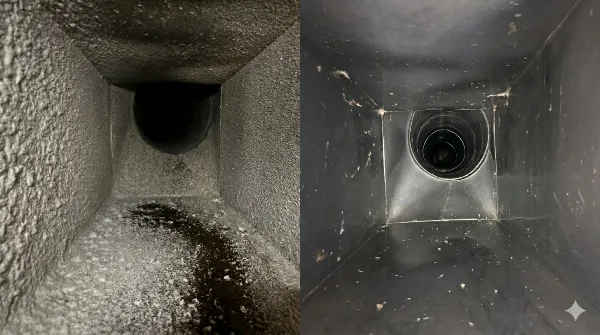
These figures are about how much grease is allowed to build up between cleans. They help decide when a system needs cleaning. The cleaning itself should remove the grease throughout the system, and the before and after photos in your report show the difference.
Where readings are taken
Readings are taken at set points along the system, so the results give a fair picture rather than one clean or dirty spot. Typical points include:
- The canopy and the plenum behind the filters.
- Horizontal duct runs, close to the canopy and further along.
- Bends, junctions and the base of risers.
- The extract fan housing.
- Near the discharge.
Each reading is recorded with its location and a photo, so the next test can be taken in the same places and compared.
Points that can’t be reached are noted too, because a gap in the readings is itself useful information. It usually means a section of duct that also can’t be cleaned, and may need an access panel.
How the results are used
- Setting the cleaning interval. BESA’s minimum frequencies (every 3, 6 or 12 months, by daily hours of cooking) are minimums. A competent person’s risk assessment, based on grease measurement, sets the real interval.
- Finding hot spots. A single reading of 500 microns or more means that spot needs cleaning straight away, even if the rest of the system is fine.
- Before and after a clean. Readings before a clean show what was there. Readings after show what was achieved, alongside the photos in your report.
- Evidence. Insurers and inspectors may ask how you decided your cleaning interval. A report with readings answers that.
What you get
A report with each reading, its location and a photo, the mean across the system, any points that need spot cleaning and our recommendation: clean now, clean at the next scheduled date, or test again at a set interval. Our article on grease thickness testing explains the methods in more detail.
If you have readings from earlier tests or previous cleans, send them to us. Comparing results over time shows the trend, which is the most useful thing of all when setting a cleaning interval. Keep each report with your TR19 certificates and fire safety records.
When to test
- When you’ve taken over a kitchen and don’t know its history.
- When your menu, opening hours or cooking equipment have changed.
- Between cleans, to check the interval is right.
- When you want to check the result of a clean (see post-clean verification).
- As part of a pre-clean survey before a first clean.
What it costs
We don’t publish prices. It depends on the size of the system, how many access points there are and how easy they are to reach. Testing is often done as part of a survey or clean. We’ll give you a fixed quote, usually within one working day.
Send us photos and details of the system to start.
Near you
- London
- Brighton
- Southampton
- Portsmouth
- Reading
- Oxford
- Milton Keynes
- Guildford
- Chelmsford
- Maidstone
- Woking
- Crawley
Related
Grease thickness testing: common questions
What is WFTT?
The Wet Film Thickness Test, one of the two methods used to measure the depth of grease inside a kitchen extract system.
What is DTT?
The Deposit Thickness Test, the other recognised method for measuring grease deposits at set points along the system.
What grease level means we need to clean?
BESA guidance says the mean should not exceed 200 microns between cleans, and 500 microns or more at any point needs immediate spot cleaning.
Can testing mean we clean less often?
BESA’s frequencies are minimums. Testing can show you need to clean sooner, and helps you set the right interval for your kitchen.
Do you test as part of every clean?
Yes. We take readings before and after every kitchen extract clean, and record them on the photo report.
Page updated 30 October 2026