Greater London · Fire damper testing
Fire Damper Testing in Canary Wharf
Fire damper testing in Canary Wharf from ventilation hygiene specialists trading since 2009. Out-of-hours visits and 24/7 emergency callout.
- Missing or out-of-date damper records
- Dampers clogged with dust or grease
- Dampers that can’t be reached without an access panel
About our fire damper testing in Canary Wharf
Not every damper relies on heat. Smoke dampers are motorised and are opened and closed by a control system, so testing means running them through their controls and confirming every blade travels fully and comes back. The work covers riser dampers, hospitals and care homes and offices and schools, and people most often call us about fire damper items raised by an assessor and fire dampers that fail to drop shut.
Damper testing in London buildings is typically planned around the people in them, so it’s often done out of hours or one zone at a time. Access to ceiling voids and risers is agreed with the building manager first.
Think of the report as the system’s health record: a dated account with photos of everything we did. Grease extract cleans are also certificated to TR19® Grease through the BESCA VHE portal, ready for your insurer.
- Location
- Canary Wharf (E14, SE16, E22)
- Wider area
- Greater London
- Paperwork
- Written report with photos
- Price
- Fixed quote, typically within a working day
- When we work
- When your site is closed, plus a 24/7 line
- Call
- 0345 646 2711
- Updated
- 30 October 2026
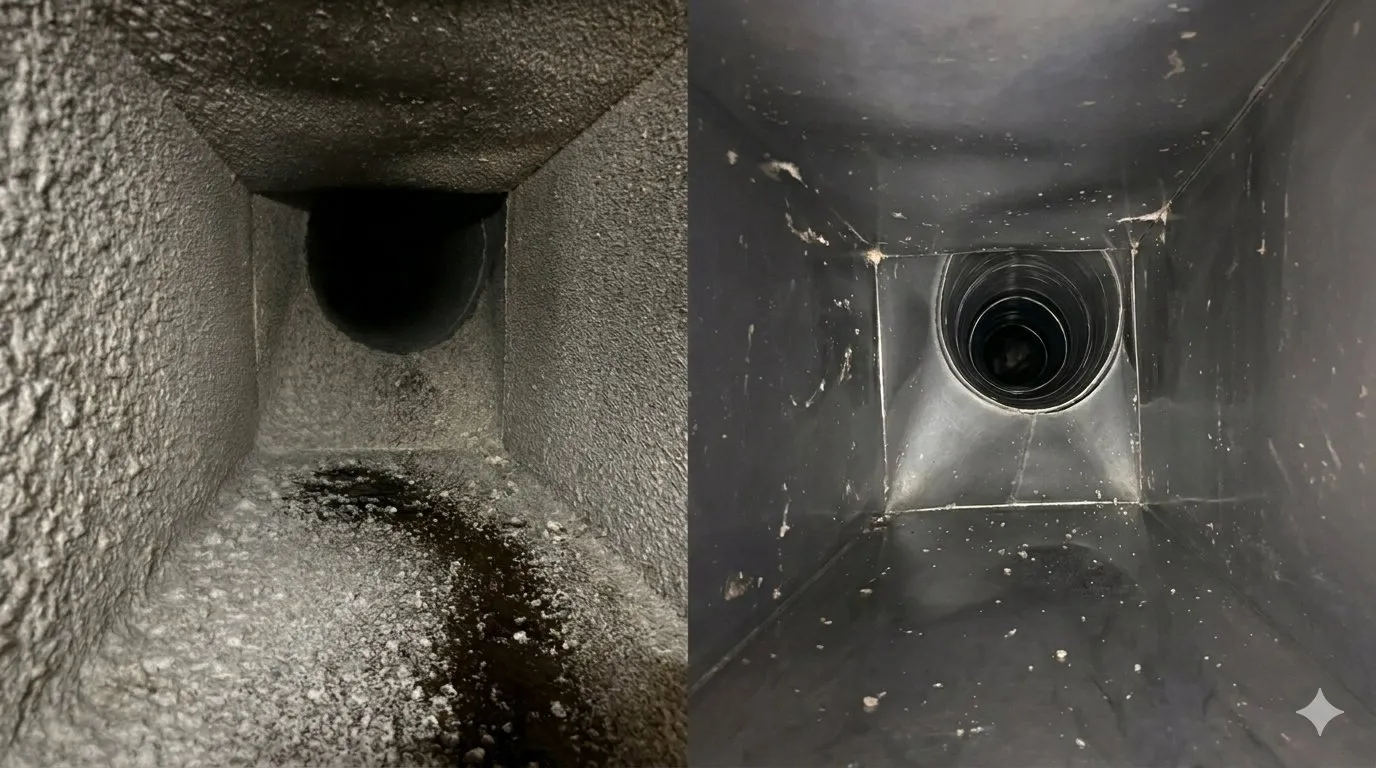
Why it’s worth doing now in Canary Wharf
If a damper can’t close, the wall it sits in has a hole in it during a fire. The rest of the compartment can be built perfectly and still be bypassed by the duct. It’s far better to find that out on a test than in a fire. Choosing the date yourself beats having a fault choose it for you.
Leaving it longer rarely makes the work cheaper. Build-up, wear and faults tend to get worse, not better, which can make the next visit longer. If you’re unsure, give us a ring on 0345 646 2711 or send us an email for straight advice and a fixed quote.
Why Canary Wharf businesses choose us
- Survey first, then a fixed quote
- Trading since 2009
- Accredited under CHAS and SafeContractor, with ISO 9001
- We are fully insured
Read how cleaning jobs are priced and our accreditations and certificates.
What staff can safely do
In-house cleaning and specialist cleaning do different jobs. A daily filter wipe and a weekly filter wash keep grease down at the front of the system, but they do not reach the grease that builds up further in. Reaching it takes a specialist with the right equipment.
For ventilation and air handling systems, in-house care is mostly about checks: keeping grilles clear, noting unusual noise or smells and logging filter changes. Cleaning inside ducts and units is specialist work.
What the work involves, part by part
Schools, hospitals and care homes
Where residents cannot easily get out, holding fire and smoke back matters even more. Regular damper testing supports that.
Fusible link fire dampers
For dampers closed by a spring, BESA guidance is annual testing as a minimum. A weak spring or a sticking blade shows up when the damper is dropped.
Fire damper testing in Canary Wharf: local notes
Going by the FSA’s register, there are about 56 schools, colleges and universities, about 42 care, childcare and hospital premises and about 12 hotels and B&Bs serving food within roughly a mile and a half of the centre of Canary Wharf. Larger buildings like these are often divided into fire compartments, with dampers where ducts pass between them. London Fire Brigade covers Canary Wharf. Its fire safety officers enforce the Fire Safety Order in most non-domestic buildings, and that covers fire safety systems such as dampers. Poplar Hospital is the nearest hospital, about 0.7 miles north-east of Canary Wharf. Smaller healthcare sites, from surgeries to care homes, need the same annual damper test as a hospital.
Site managers at schools such as Our Lady and St Joseph Catholic Primary School normally find the summer break the easiest time for ceiling work like damper testing. Historic buildings that have had ventilation added later can hide dampers in awkward places; Queen's House, about 1.8 miles south, is one of the historic houses in the area around Canary Wharf.
Canary Wharf is about 2 miles north-west of Greenwich, in Greater London. We carry out fire damper testing for commercial premises of every kind in Canary Wharf and the rest of Greater London. 764 places in Greater London are on our list, large and small.
Fire damper testing in E14, SE16 and E22 follows the same survey, fixed quote and written report as everywhere else we cover. Whether your site is on Castor Lane, Cassilis Road and Dockyard Lane or anywhere close by, our technicians can take on the work. Canary Wharf is on the A1261, which makes it straightforward for our technicians to reach for fire damper testing. Nearby, we also carry out fire damper testing in London Docklands (1 mile east), Poplar (1 mile north-east), Heron Quays (1 mile south-west), Coldharbour (1 mile east) and Blackwall (1 mile east). Within a short drive, we also cover London (3 miles west), City of Westminster (6 miles west), Marylebone (6 miles west), Kensington (8 miles west), St Pancras (4 miles west) and Shoreditch (3 miles north-west).
Near you in Canary Wharf
We work in commercial kitchens and buildings around Tower Hamlets College, Sir John McDougall Gardens and The Ledger Building pub and the streets around them. Canary Wharf has its own railway station: Canary Wharf station. Other landmarks nearby include The Pumphouse Educational Museum (0.8 miles west) and Surrey Quays Shopping Centre (1.4 miles south-west). Not far away are St. James's Park Lake and Tower Hill.
When to call us in Canary Wharf
Other trades work around dampers all the time. Cables get run through them, links get knocked and blades get wedged open, and any of those can stop a damper closing.
It’s time to book a visit if you see:
- Dampers hidden with no access panel or hatch
- Dirty dampers that may not close
- Fire dampers that haven’t been tested for over a year
- Rusted damper blades and springs
Wherever there are offices above shops, near Canary Wharf station or elsewhere in Canary Wharf, ductwork may cross fire-resisting floors, and any dampers need testing.
What to look for in a quote
- If they look at the system before pricing
- If the quote is a fixed price or an estimate
- Whether the work can be done while the site is closed
- Their accreditations, such as BESCA Vent Hygiene Elite, CHAS or SafeContractor
Canary Wharf: your questions answered
Is parking a problem for work in Canary Wharf?
Tell us where a van can stop near your site in Canary Wharf, and about any building rules on loading. If the building has a loading slot system, we will book into it.
Can you come to Canary Wharf after we close?
Yes, we can come after you close and finish before you open. That way a site in Canary Wharf does not have to lose a day’s trading. When you call 0345 646 2711 or drop us a line, mention when the site is quiet.
What if parts of the system can’t be reached?
They’re marked on the report. In ductwork, new access panels are often the answer, and we can fit those.
Is there a survey before the work?
Yes, every time. Diagnosis comes before treatment: the survey shows what needs doing and what access we need and the fixed quote is built on it.
What if a fire damper will not close?
We note the failure and what we found. We can then repair or replace the damper as a remedial job with a fresh test at the end.
Can you price the work without visiting?
Often, yes. Photos of the system and the access, plus your opening hours and last report, are often enough. Larger or hidden systems need a survey on site first.
What happens to the waste?
Anything we remove is contained as we work and taken away with us, including grease, debris and dirty water. None of it is left on site.
What information do you need?
Some photos and a quick description of the system, with the address and opening hours. If we need more, we will ask.
The process
We turn up at the time agreed with you, which is often after service, overnight or at a weekend. Anything that needs to be off for the work is switched off and left to cool first, and floors and nearby surfaces are sheeted. The work itself takes anything from a couple of hours for a handful of dampers to a full day for a large building. In a London area like Canary Wharf, parking, loading and building access are planned before the day of the work.
- We start with whatever records exist: registers, drawings or old reports.
- Each damper is located and reached through its access panel.
- Fire dampers are drop tested and smoke dampers are run through their controls.
- Dampers that close fully are reset and left open.
- We report on every damper, with faults and suggested remedials set out.
Before we arrive
- Make sure someone can let us in and lock up afterwards
- Mention any locked doors, roof access or ceiling voids
- Have your last certificate or report to hand
Get a fixed quote
Getting a quote doesn’t take long. Call or email with a few details and you will normally have a fixed price within one working day. If we need to see the system first, we book a survey around your hours.
Advice
Landlords, agents and facilities managers
Records are where multi-site compliance often slips. Each visit ends with a dated report and photos, so you can show an insurer or inspector what was done at each site.
If you look after several sites, we can plan visits across the whole estate and price them together. Each site gets its own report and pictures, so records stay tidy.
What fire damper testing cannot fix
Not every problem is solved by fire damper testing, and we’d rather say so up front. It won’t put right:
- Fire-stopping gaps around the duct where it passes through the wall
- Fire alarm or control system faults behind a smoke damper
- Fire risk assessments, which need a fire risk assessor
Not sure which it is? You can give us a ring on 0345 646 2711 or send us an email and we’ll tell you honestly before you book.
Parts of the system we cover
- Hospitals and care homes
- Wall and floor dampers
- Riser dampers
- Motorised smoke dampers
- Fusible link fire dampers
- Offices and schools