Kent · Ductwork cleaning
Ductwork Cleaning in Styants Bottom
Our technicians work in Styants Bottom on ductwork cleaning. Fixed quotes, work around your opening hours and photo reports as standard.
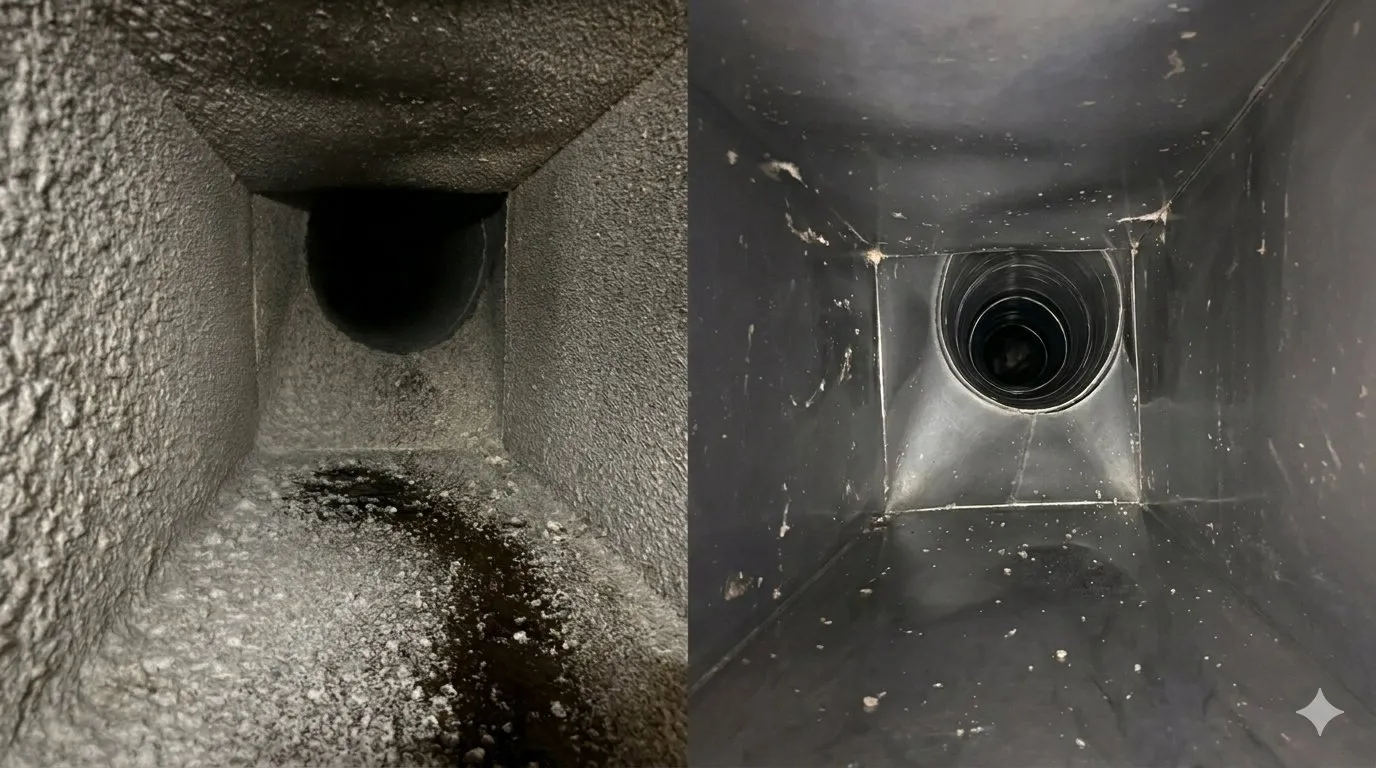
- Hardened, baked-on grease in long horizontal runs
- A grease test showing the duct is overdue
- Thick deposits at the bottom of a vertical duct
Ductwork cleaning for kitchens and businesses in Styants Bottom
Grease in a duct is hidden, which is exactly why it’s dangerous. Flames pulled in from the cooking line can ignite it, carrying a fire along the duct and into rooms far from the kitchen. Removing it is the whole point. The work covers vertical risers, horizontal duct runs and access panels, and the jobs we see most are hardened, baked-on grease in long horizontal runs and duct runs with no cleaning record.
In a village or hamlet like Styants Bottom, the kitchens that need extract cleaning are normally a pub, a school, a care home or a hall kitchen, wherever there is one. Each still has a canopy and duct that collect grease, whatever the size of the place.
The paperwork matters as much as the work. You get a written report with photos after every visit, listing what was done, anything we couldn’t reach and when the next visit is due. Keep it with your fire safety records so it’s to hand when an insurer or inspector asks.
- Place
- Styants Bottom (TN15)
- Region
- Kent
- Reporting
- TR19® certificate and photo report
- Quotes
- A fixed quote up front
- Working hours
- Evenings, overnight and weekends; 24/7 emergencies
- Telephone
- 0345 646 2711
- Last updated
- 30 October 2026
What staff can safely do
Some jobs should never be done in-house: entering ducts, working on fans, testing dampers and taking grease readings need training, the right equipment and safe access. Leave those to us.
Staff cleaning and specialist work are not the same thing. Wiping filters daily and washing them weekly keeps the visible parts in order, but grease that has passed the filters is out of reach. That part needs specialist access and equipment.
When something else is needed
A few issues sit outside what this work can do:
- Ductwork that was poorly designed
- Leaking duct joints that need repair
- An extract fan that has stopped working
Not sure which it is? You can call 0345 646 2711 or drop us a line and we’ll tell you honestly before you book.
What the work covers
- Access panels
- Multi-storey ducts
- Attenuators
- Vertical risers
- Bends and junctions
- Horizontal duct runs
What affects the cost of ductwork cleaning
There’s no set price list, because no two systems are the same. What we look at:
- Travel, parking and unloading
- The scale of the work
- The condition we find in the survey
- Whether several sites go on one quote
When the work has to happen, how we reach it and how big the site is all affect the cost. Each of those is built into the quote, and the price is fixed before we start.
What we need to know
We can often survey from pictures. The most useful are:
- Any previous report or certificate
- Your opening hours and when the area is out of use
- Anything you’ve noticed, such as smells, noise, drips or poor airflow
- Close-ups of filters, grilles, hatches or access panels
Photos are enough for some jobs, while others need a look on site. Big or complicated sites, and systems that are hard to see in pictures, get a survey first. Either way, the quote is fixed before any work is booked.
Different parts, different methods
Multi-storey and shared buildings
Ducts in taller or shared buildings often run past other occupiers. We plan access with you and the building manager, so the clean is done safely and quietly.
Vertical risers
In taller buildings, a riser may pass through several floors and fire compartments, where fire dampers may be fitted. We test those as a separate job.
Looking after it afterwards
Looking after the system between visits is straightforward, and it helps at the next visit:
- Check readings when the menu changes
- Flag drips from the duct straight away
- Consider fitting panels where the report shows gaps
- File each certificate and photo report in the maintenance log
The report names every part of the duct that couldn’t be reached, with the reason. You can then decide whether to have access panels fitted.
Have access panels fitted where sections can’t be reached. It doesn’t stop grease forming, but it stops it building unseen.
What we do, step by step
On the day, we arrive at the time agreed with you, often in the evening, overnight or at the weekend so the site keeps working. Anything that needs to be off for the work is switched off and left to cool before work begins, and floors and nearby surfaces are sheeted. The work itself takes a shift or more, depending on the length of the runs and the number of access points. Somewhere like Styants Bottom, lanes, gates and parking are worth mentioning in advance.
- The duct route is surveyed and every access point found.
- Grease thickness is measured at set points.
- Out of hours, the area is protected and the access panels opened.
- Heavy deposits come out by hand, then each section is degreased.
- Panels are closed, readings and photos repeated, and unreachable sections recorded.
Before we arrive
- Make sure someone can let us in and lock up afterwards
- Find the previous report, if there is one
- Let us know about permits to work or site inductions
Get a fixed quote
The quickest way to a quote is to send pictures: the system from a couple of angles, plus any access panels or hatches. Add the site type and your opening hours, and many jobs can be priced from that alone.
Related advice
Common questions in Styants Bottom
Do you work at weekends in Styants Bottom?
Yes, evening, overnight and weekend work is normal for us. The work in Styants Bottom can fit around your hours. Just give us a ring on 0345 646 2711 or send us an email with your opening times and we’ll plan around them.
Do you work in villages like Styants Bottom?
Yes. Villages and rural sites across the South East are part of our work, Styants Bottom included. A survey first, from pictures or a visit, means we arrive with the right kit.
What happens if there aren’t enough access panels?
Every reachable section is cleaned and the rest recorded. Extra panels can be installed, and we can do that for you.
Can we book visits on a schedule?
Yes. Regular plans can run on 3, 6 or 12-monthly cycles, to suit the system and how it’s used.
How do you clean inside the ductwork?
We get into the duct through its access panels. Thick deposits are removed by hand before degreasing, such as degreasers, hot water or steam.
Do you have insurance?
Yes. We carry full insurance and have been trading since 2009.
Who is the responsible person?
That depends on who controls the premises. Under the Fire Safety Order 2005, it’s the responsible person, which can be the employer, the owner, a landlord, an FM or a managing agent.
Do you look at the system first?
Yes. Photos often do the job, and larger or hidden systems get a visit.
Kitchen extracts in Styants Bottom
The FSA’s food hygiene register includes about 4 pubs and bars within 1.5 miles or so of the middle of Styants Bottom. A pub or hotel kitchen that cooks every day builds up grease in its extract like any other. Kent Fire and Rescue Service covers Styants Bottom. In most workplaces, including commercial kitchens, it’s the fire and rescue authority that enforces the Fire Safety Order. It’s Sevenoaks council that sends environmental health officers to food businesses in Styants Bottom. Extraction counts as kitchen equipment, so its condition can come up on the day. A TR19® certificate and photo report after each clean gives you a record to show an inspector.
If you run a church or community hall kitchen, near St Lawrence or elsewhere in Styants Bottom, its extract still collects grease from every lunch and event. Historic houses near Styants Bottom, such as Ightham Mote about 1.9 miles south, are a reminder that older buildings with event kitchens can have long, awkward duct routes. Kitchens that cook twelve hours or more a day, as some healthcare kitchens do, fall into BESA’s three-monthly minimum; Sevenoaks Hospital is the nearest hospital to Styants Bottom, about 2.8 miles west.
Styants Bottom is about 3 miles east of Sevenoaks, in Kent. We provide ductwork cleaning for businesses, landlords and public buildings in Styants Bottom and the rest of Kent. We cover 922 places across Kent, from busy centres to quieter spots. Our Maidstone page covers sites nearby, about 12 miles away.
We cover every part of the TN15 postcode area for ductwork cleaning and the roads nearby. If your site is just outside Styants Bottom, we cover Oldbury (1 mile east), Ightham (1 mile south-east), Stone Street (1 mile south), Ivy Hatch (1 mile south-east) and Bitchet Green (2 miles south). Further out, we also cover Maidstone (12 miles east), Dartford (11 miles north), Sevenoaks (3 miles west), Royal Tunbridge Wells (10 miles south), Gravesend (11 miles north-east) and Tonbridge (6 miles south).
Around Styants Bottom
Typical jobs here are in premises near Wrotham School, The Harrow Inn and Ivy Hatch Nature Reserve. The nearest railway station is Kemsing station, about 1 mile north-west of the centre. Nearby you will also find Ightham Court (1.3 miles north-east) and Sevenoaks Hospital (2.8 miles west). Green spaces nearby include Dryhill Nature Reserve.
Why it’s worth doing now in Styants Bottom
A fire in a greasy duct is hard to reach and hard to stop. The duct can carry it to rooms, floors or roof spaces well away from the kitchen, so cleaning the duct is as important as cleaning the hood. If the system at a site near Styants Bottom fails, there may be nowhere nearby to move to.
What you pay reflects the actual work. That is why every job is surveyed first, and why the quote is fixed before any work starts.
Why choose Duct Doctor in Styants Bottom
- CHAS, SafeContractor and ISO 9001
- Fixed quotes, usually within one working day
- We are fully insured
- Survey first, then a fixed quote
Read how cleaning jobs are priced and how to check a contractor.