Kent · Ductwork cleaning
Ductwork cleaning in Stone Street, Kent
Ductwork cleaning across Stone Street and nearby, booked around your opening hours and finished with a written report and photos.
- A grease test showing the duct is overdue
- A duct clean needed for an insurer
- Duct runs with no cleaning record
Ductwork cleaning in Stone Street
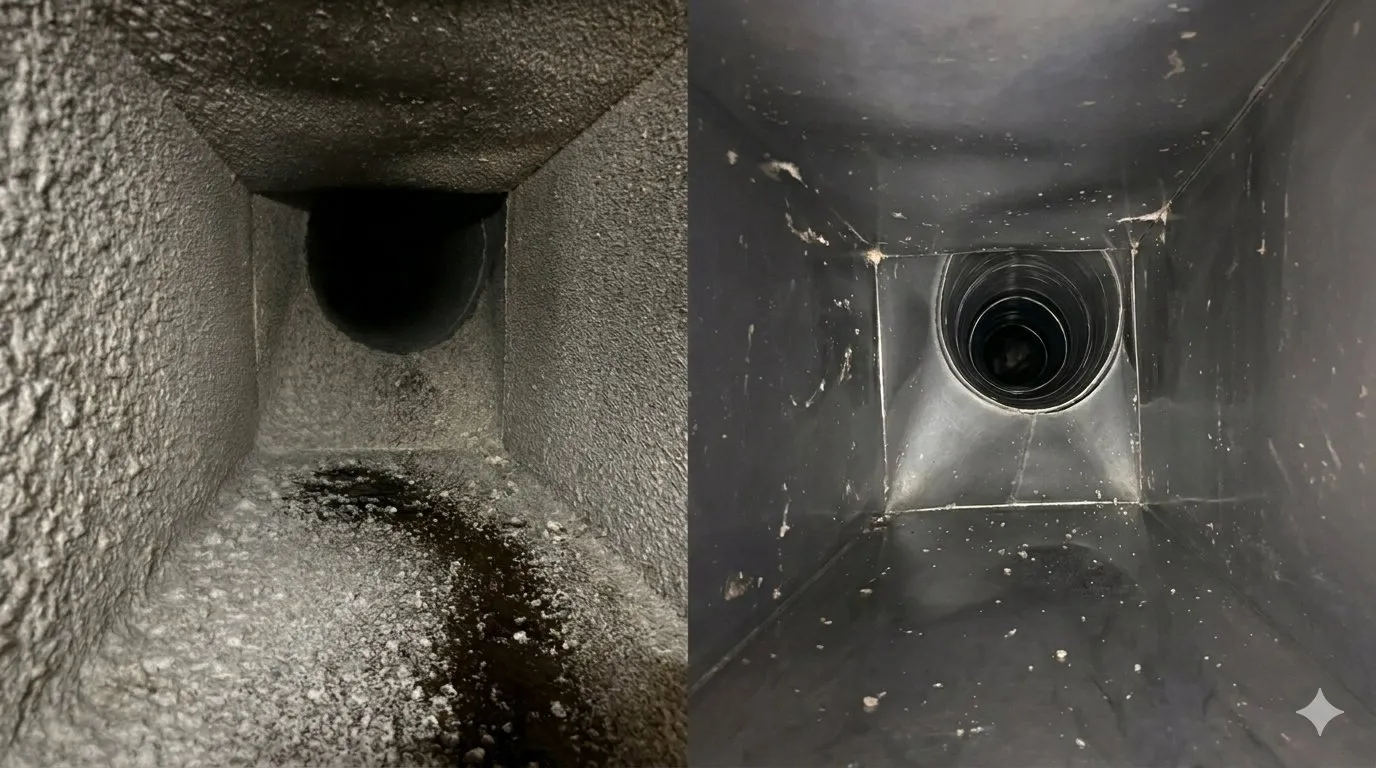
Once air leaves the canopy, it travels through ductwork that most people never see. Grease settles along every metre of it and a fire in the duct can spread through the building. Our ductwork cleaning reaches inside the runs and risers through access panels, to BESA TR19® Grease. If you’re dealing with a duct clean needed for an insurer and hardened, baked-on grease in long horizontal runs, we can help.
Rural kitchens often have long, low duct runs through a roof space or along an outside wall, and those horizontal sections are where grease settles. Access, parking and timings are agreed before the day.
Think of the report as the system’s health record: a dated account with photos of everything we did. For TR19® Grease cleans, the certificate comes through the BESCA Vent Hygiene Elite portal and sits alongside the report.
- Where
- Stone Street (TN15)
- Wider area
- Kent
- Paperwork
- TR19® certificate and photo report
- Quote
- A fixed quote up front
- When we work
- Overnight and weekend work, 24/7 emergency callout
- Telephone
- 0345 646 2711
- Updated
- 30 October 2026
What ductwork cleaning cannot fix
We’d rather tell you now than book work that won’t help, so here are the limits:
- Faulty fire dampers
- A duct that’s too small or badly routed for the kitchen (a design issue)
- Leaking duct joints that need repair
If you’re not sure, just call 0345 646 2711, or email photos and we will give you a straight answer.
What the work covers
- Bends and junctions
- Multi-storey ducts
- Access panels
- Attenuators
- Vertical risers
- Horizontal duct runs
How we price ductwork cleaning
A fixed price needs a few facts first. We check:
- How many systems or sites are involved
- Any permits to work or inductions
- Where the site is and how we reach it
- The times the site is available
Putting the work off seldom saves money. Build-up, wear and faults tend to get worse, not better, which can make the next visit longer. If you’re unsure, call 0345 646 2711 or email us and we will give you an honest view and a fixed quote.
Helping us quote
To help us quote quickly, send us:
- Detail shots of panels, filters and grilles
- Any previous report or certificate
- Where the site is and what kind of site it is
- The times we could work without disrupting the site
Quoting starts with a diagnosis, from your photos and details or, where that isn’t enough, a survey on site. After that, you get a fixed price for the work, before any work starts.
Keeping the system healthy
How long the results last depends on use and care. Here’s what we suggest:
- Do not block access panels with shelving or stock
- Run the extract fan throughout service
- Keep to the interval on the report
- Never cook with a filter missing
The report gives a recommended next clean date, based on the readings and your daily cooking hours, in line with BESA guidance.
Keep the fan on throughout service. Moving air carries vapour through rather than letting it settle, so switching off early adds to the build-up.
Kitchen extracts in Stone Street
Food Standards Agency records list about 4 restaurants, cafés and works canteens within about 1.5 miles of central Stone Street. Each kitchen that cooks under a canopy sends grease-laden air into a duct, where it cools and settles. Kitchens in Stone Street get their food hygiene inspections from Tonbridge and Malling council. They look at how clean the premises and equipment are, and the kitchen extract is part of that. A TR19® certificate and photo report after each clean gives you a record to show an inspector. Kent Fire and Rescue Service covers Stone Street. Fire and rescue authorities enforce the Fire Safety Order in most non-domestic premises, and in a kitchen that fire risk includes the grease in the extract.
If you run a church or community hall kitchen, near St Lawrence or elsewhere in Stone Street, its extract still collects grease from every lunch and event. If you look after a school kitchen, at a school such as St Lawrence Church of England Primary School or anywhere near Stone Street, the holidays are the usual time for a TR19® clean. Healthcare kitchens, like those at hospitals such as Sevenoaks Hospital (about 2.8 miles north-west), often cook for long hours, which puts them in BESA’s heavier-use bands.
Stone Street is about 3 miles east of Sevenoaks, in Kent. Whether your site is in the middle of Stone Street or further out, we cover ductwork cleaning for every kind of premises, from small sites to large estates. We cover 922 places across Kent, from busy centres to quieter spots. You can also see our page for Maidstone, roughly 12 miles from Stone Street.
Ductwork cleaning in TN15 follows the same survey, fixed quote and written report as everywhere else we cover. Local streets include Church Road, Stone Street Road and Pond Lane, and we cover them all for ductwork cleaning. Neighbouring places we cover for ductwork cleaning include Bitchet Green (1 mile south-west), Ivy Hatch (1 mile east), Styants Bottom (1 mile north), Godden Green (1 mile west) and Ightham (1 mile north-east). We also work in nearby towns such as Maidstone (12 miles east), Dartford (12 miles north), Sevenoaks (3 miles west), Royal Tunbridge Wells (9 miles south), Gravesend (12 miles north-east) and Tonbridge (5 miles south).
Landmarks near Stone Street
Locally, jobs take us to businesses close to Sevenoaks Preparatory School, Ivy Hatch Nature Reserve and The Plough pub and the streets around them. The closest station to Stone Street is Kemsing station, roughly 1.9 miles north. Other landmarks nearby include Ightham Court (2.2 miles north-east) and Sevenoaks Hospital (2.8 miles north-west). For a walk, there’s Dryhill Nature Reserve.
Why deal with it now?
TR19® isn’t law, but the duty to manage fire risk is. The Fire Safety Order 2005 makes the responsible person assess and reduce fire risk, including the grease inside the extract ductwork. Out of sight is the usual reason a rural system goes too long without attention.
What you pay reflects the actual work. That is why every job is surveyed first, and why the quote is fixed before we start.
Why us?
- Survey first, then a fixed quote
- Fixed quotes from a survey or pictures
- Trading since 2009
- Full insurance on every job
Read what affects the cost and our accreditations.
Different parts, different methods
Vertical risers
In taller buildings, a riser may pass through several floors and fire compartments, so fire dampers may be fitted where it crosses them. Damper testing is a separate service.
Bends and transitions
Bends, elbows and changes of size are where grease collects most. Slowing air leaves grease behind, so these points get extra attention.
Places near Stone Street
Also in Stone Street
For landlords and multi-site operators
We work for landlords, managing agents and facilities managers as well as the people running the site. Shared systems, like a riser serving several units, need a clear agreement on who books the work, and we are happy to quote for all of it.
Under the Regulatory Reform (Fire Safety) Order 2005, the responsible person must assess and reduce fire risk, and that can be the employer, the owner, a landlord, a facilities manager or a managing agent. Where responsibility is shared, records matter even more.
How it works
Your trading hours come first. We book the visit for a time the area is closed, whether that’s an evening, overnight or a weekend. Once we’re in, the area is sheeted and anything that has to be off is turned off and cooled, and the work takes from a few hours to more than one visit, depending on duct length and access. If the van will struggle with a lane or gateway near Stone Street, let us know and we’ll plan around it.
- We trace the duct and find every way in.
- We take grease readings along the route.
- Once the kitchen has closed, we protect the area and open the panels.
- Heavy deposits come out by hand, then each section is degreased.
- Panels are closed, readings and photos repeated, and unreachable sections recorded.
Getting ready for the visit
- Let us know when the site is closed or quiet
- Find the previous report, if there is one
- Mention any sign-in, permit or induction we need
How to get a quote
There’s no standard price list, because no two systems are the same. Instead, we look at your site first, from pictures or a survey, then send a fixed quote. To start, call 0345 646 2711 or send us an email.
Related advice
Common questions in Stone Street
Do you work at weekends in Stone Street?
Yes, nights and weekends are routine for us. The site is handed back ready to open. Let us know the hours you’re closed and we will book within them.
Who would carry out a food hygiene inspection at a kitchen in Stone Street?
The local authority for Stone Street is Tonbridge and Malling council, and its environmental health team does the inspecting. It helps to keep the extract cleaning records with your food safety paperwork, so they’re ready if asked for.
How can I tell if my extract ducts are dirty?
A grease thickness test gives the answer. Using a Wet Film Thickness Test or Deposit Thickness Test, we check the grease at set points. BESA guidance says the mean shouldn’t exceed 200 microns, and 500 or more anywhere needs immediate spot cleaning.
Do you have a 24/7 line?
Yes, any time. For anything urgent, such as a fan failure or damage after a fire, ring the 24/7 line, and we’ll advise on what to do next.
Can we book visits on a schedule?
Yes. Plans on a 3, 6 or 12-monthly cycle are available, depending on what the system needs.
How much does ductwork cleaning cost?
It depends on the site, so we quote each one individually. To get one, give us a ring on 0345 646 2711 or drop us a line and tell us about the site and its opening hours.
Can extra access doors be added to the duct?
Yes, we install duct access panels. We place them where they help most, and we’ll recommend where.
How often does extract ductwork need cleaning?
It follows the same interval as the whole extract, from every 3 months for heavy use to every 12 months for light use. Readings tell you if it needs to be more often.