Kent · Ductwork cleaning
Pollhill ductwork cleaning
Professional ductwork cleaning in and around Pollhill, booked around your opening hours and signed off in writing with photos.
- A duct nobody has opened in years
- Stale grease odours from the duct
- Grease leaking from duct joints
About our ductwork cleaning in Pollhill
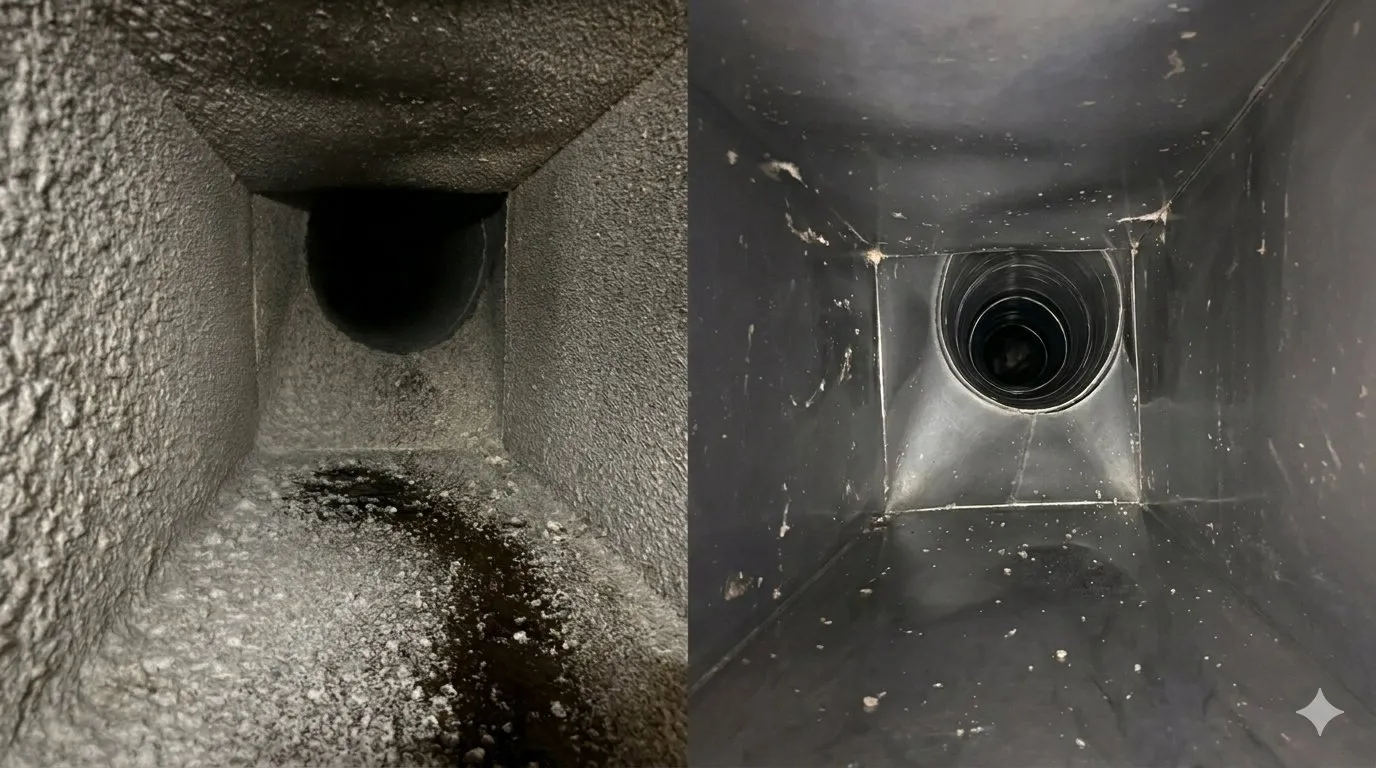
Ductwork in Pollhill is cleaned the same thorough way as everywhere else we work: readings at set points, heavy grease scraped out by hand, then degreasing to suit the deposit. Post-clean readings and pictures complete the record. We are often asked to deal with duct runs with no cleaning record and sections of duct with no access panels, across access panels, horizontal duct runs and attenuators.
For a kitchen in or near Pollhill, the visit is planned around opening hours and the journey, and the clean covers the whole system, as it would anywhere: canopy to discharge, then a TR19® certificate and a photo report.
The report is your system’s health record: a dated account with pictures of everything we did. Grease extract cleans are also certificated to TR19® Grease through the BESCA VHE portal and sits alongside the report.
- Where
- Pollhill (ME17)
- Wider area
- Kent
- Reporting
- TR19® certificate and photo report
- Quotes
- A fixed price before we start
- When we work
- Evenings, overnight and weekends; 24/7 emergencies
- Call
- 0345 646 2711
- Updated
- 30 October 2026
Your questions about ductwork cleaning in Pollhill
Which fire authority looks after Pollhill?
That’s Kent Fire and Rescue Service. TR19® isn’t law, but it’s the benchmark many fire officers and insurers look to when they ask how often the extract is cleaned.
Do you clean school canteen extracts around Pollhill out of term?
Yes, holiday work suits schools best. Around Pollhill, the Food Standards Agency lists about 2 schools and colleges with registered kitchens within a mile and a half or so. You can phone us on 0345 646 2711, or email photos with the dates the site is empty.
Are you insured?
Yes, fully. CHAS and SafeContractor accreditation sit alongside it for clients who vet their contractors.
What happens to the waste?
Anything we remove is contained as we work and taken away with us, including grease, debris and dirty water. None of it is left on site.
What does TR19 mean?
BESA’s ventilation hygiene specification, with two parts that matter most here: TR19® Grease for kitchen extract systems and TR19® Air for general ventilation. It is not law, but it’s the benchmark.
What accreditations do you have?
CHAS, SafeContractor, ISO 9001 and BESCA Vent Hygiene Elite membership, cleaning to BESA TR19® Grease. We’re fully insured and have been trading since 2009.
Which kinds of sites do you work on?
Any commercial site with kitchens or ventilation, from a single café to a large school. We work with hotels, schools, care homes, offices, retail and leisure sites.
Is Pollhill in your area?
Yes. We work across Greater London, Surrey, Kent, Sussex, Hampshire, the Isle of Wight, Berkshire, Buckinghamshire, Oxfordshire, Hertfordshire and Essex, and that includes Pollhill.
How the job changes from site to site
Access panels
Every section of duct is cleaned through an access panel. Without them, parts of the duct cannot be reached and the report has to say so.
Vertical risers
Risers carry the extract up through the building to the roof. Grease runs down the walls and gathers at the base, so the base is one of our test points.
When to call us in Pollhill
Wherever the kitchen is, in Pollhill or elsewhere, the duct fills in the same way: daily cooking hours, the menu and the state of the filters. Under BESA guidance, the minimum interval is 3, 6 or 12 months, by daily cooking hours.
Clients normally contact us when they notice one of these:
- Duct runs with no cleaning record
- A rancid smell from the extract duct
- Gaps where access panels were never fitted
- Grease leaking from duct joints
Kitchens that cook twelve hours or more a day, as some healthcare kitchens do, fall into BESA’s three-monthly minimum; KIMS hospital is the nearest hospital to Pollhill, about 5.7 miles north-west.
What your quote should include
- Exactly which parts of the system are covered
- Whether the quote is based on a survey or photos
- Whether the work can be done while the site is closed
- Whether the figure could change on the day
Staff cleaning versus specialist work
For ventilation and air handling systems, in-house care is mostly about checks: clear grilles, a log of filter changes and reporting anything odd. Cleaning inside ducts and units is specialist work.
Staff cleaning does not replace a specialist visit; it supports it. Clean filters and tidy surfaces slow the build-up, but the parts you can’t see still need a specialist at the right interval.
How we price ductwork cleaning
Some jobs are bigger than they look, and some smaller. The main factors:
- Site rules, permits and inductions
- The scale of the work
- When the work can happen, such as evenings, overnight or weekends
- The number of sites or systems
The price reflects the work, not guesswork. That’s why we survey first, from photos or on site, and the price is agreed before work begins.
What we need to know
To help us quote quickly, send us:
- Wide pictures of the system and the area around it
- The roof, plant room or outside wall the system runs to
- The times we could work without disrupting the site
- Close-ups of filters, grilles, hatches or access panels
Photos are enough for some jobs, while others need a look on site. Larger sites, and anything hidden behind walls, ceilings or floors, are normally surveyed first. Either way, you get a fixed price before any work starts.
What ductwork cleaning cannot fix
Not every problem is solved by ductwork cleaning, and we’ll tell you before we start. It won’t put right:
- Leaking duct joints that need repair
- Faulty fire dampers
- A worn-out fan that needs replacing
If you’re not sure, just call 0345 646 2711, or send details by email and we’ll give you a straight answer.
Parts of the system we cover
- Multi-storey ducts
- Access panels
- Bends and junctions
- Attenuators
- Horizontal duct runs
- Vertical risers
Pollhill kitchens: local notes
According to Food Standards Agency records, there are about 3 pubs and bars within 1.5 miles or so of the middle of Pollhill. Where they serve hot food, their kitchen extracts need cleaning to TR19® like any restaurant’s. Fire safety in Pollhill falls to Kent Fire and Rescue Service. Grease in a kitchen extract is a recognised fire risk, and the fire authority enforces the law on managing it in most commercial premises. Environmental health officers from Maidstone council inspect food businesses in Pollhill. A greasy canopy or dripping filters are the sort of thing an inspection can pick up. A dated certificate in the maintenance file answers the question before it’s asked.
A kitchen near Harrietsham station that serves breakfast and dinner can run its extract twelve hours or more, which shortens the cleaning interval. A hall kitchen that only cooks for events, whether near Catholic Church of the Good Shepherd or elsewhere in Pollhill, still needs its extract cleaned, just less often.
Pollhill is about 6 miles east of Maidstone, in Kent. Anywhere in ME17, we cover ductwork cleaning for commercial sites. Pollhill is one of 922 places in Kent we cover for ductwork cleaning. Our Maidstone page covers sites nearby (6 miles or so).
Every address in ME17 is within our area for ductwork cleaning, from busy streets to back roads. Streets in the area include Horwood Way, Shrubwood Close and Parkfield Close, all of which we cover for ductwork cleaning. Other places close to Pollhill include Harrietsham (1 mile east), Chegworth (1 mile north-west), Marley (1 mile east), Fairbourne Heath (1 mile south) and Broomfield (1 mile west). Further out, we also cover Maidstone (6 miles west), Ashford (11 miles south-east), Sittingbourne (8 miles north-east), Faversham (11 miles north-east), Minster (14 miles north-east) and Kings Hill (11 miles west).
Around Pollhill
We work in commercial kitchens and buildings around The Lenham School, Kiln Wood and The Roebuck Public House and the streets around them. The nearest railway station is Harrietsham station, roughly 0.5 miles north-east of the centre. Well-known places in the area include Leeds Castle (1.6 miles north-west) and The Dog Collar Museum (1.5 miles west).
Places near Pollhill
Other services in Pollhill
How the visit works
Protection comes first: floors, worktops and anything near the work are covered. After that, the system is made safe and the work begins. The work on site takes anything from a few hours to several visits, depending on the length of duct, and the area is cleaned down before we leave. If the van will struggle with a lane or gateway near Pollhill, let us know and we will plan around it.
- First the duct route is traced and every access point noted.
- Set points along the runs are tested for grease.
- Access panels are opened and heavy deposits scraped out by hand.
- Horizontal runs and risers are then degreased by the method that suits the deposit.
- Readings and photos are repeated and any section we couldn’t reach is recorded.
Getting ready for the visit
- Tell us about access, such as roof hatches, plant rooms, ceilings or locked areas
- Agree a time when the area can be out of use
- Mention any parking or loading restrictions
How to get a quote
Quotes are quick. Send a few details and pictures, and we typically reply with a fixed quote within one working day. Where a survey is needed, we arrange a time that suits the site.
Read more
Keeping the system healthy
Here’s the after-treatment advice, in brief:
- Keep your cleaning records together
- Make sure filters are seated properly
- Keep to the interval on the report
- Have the grease measured if cooking hours go up
Keep the certificate and report with the fire risk assessment. An insurer, fire officer or EHO may ask to see it, and the pictures make the duct’s condition easy to see.
Have access panels fitted where sections can’t be reached. Grease you can reach is grease that gets removed.