Kent · TR19 inspections and grease testing
TR19 inspections and grease testing in Weavering, Kent
TR19 inspection in Weavering from ventilation hygiene specialists trading since 2009. Evenings, overnight and weekends, plus a 24/7 emergency line.
- Kitchens whose menu or hours have changed
- Systems cleaned on a calendar with no measurements
- Missing TR19 certificates or history
How we handle TR19 inspection in Weavering
BESA’s minimum cleaning frequencies depend on how long the kitchen cooks each day: every 3 months for heavy use of 12 to 16 hours a day, every 6 months for moderate use of 6 to 12 hours, and every 12 months for light use of 2 to 6 hours. Those are minimums, and grease readings help set the real interval. Common call-outs are for missing TR19 certificates or history and post-clean verification after another contractor’s clean, across insurer audits, wet film thickness tests and deposit thickness tests.
In a smaller place like Weavering, the kitchens with extract systems are more likely to be a pub, a café, a takeaway or a school or care home kitchen than a big restaurant. A kitchen that cooks fewer hours still builds up grease, so cleaning is planned around how much it cooks and what the readings show.
We’re CHAS and SafeContractor accredited, we hold ISO 9001 and we’re fully insured. On top of that, we are a BESCA Vent Hygiene Elite member, cleaning to BESA TR19® Grease, and we’ve been trading since 2009.
- Place
- Weavering (ME14, ME15)
- Wider area
- Kent
- Paperwork
- TR19® certificate and photo report
- Price
- A fixed quote up front
- Working hours
- Nights, weekends or holidays to suit you
- Telephone
- 0345 646 2711
- Checked
- 30 October 2026
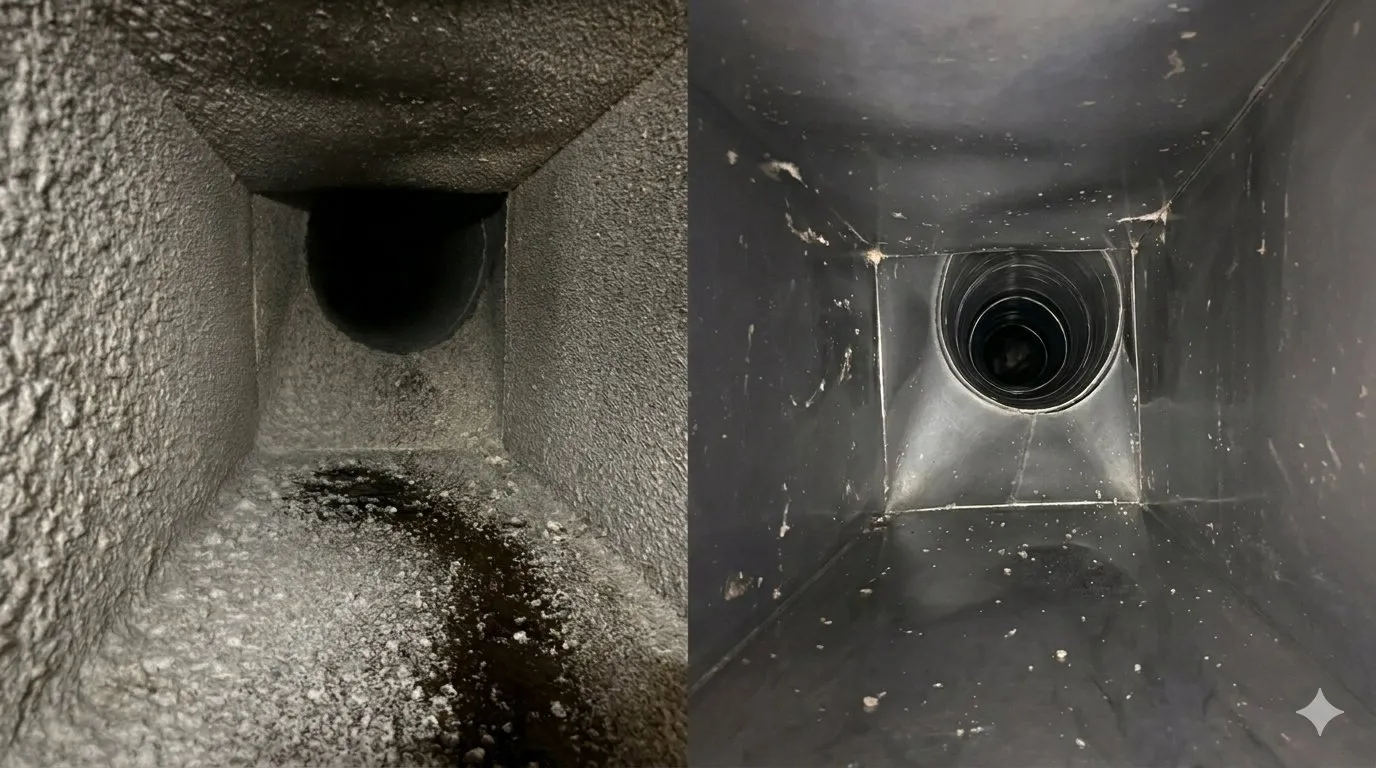
Kitchen extracts in Weavering
Food Standards Agency records include about 13 pubs and bars within roughly a mile and a half of the centre of Weavering. Any of them serving cooked food has an extract to keep clean, from canopy to discharge. In Weavering, food businesses are inspected by environmental health officers from Maidstone council. They look at how clean the premises and equipment are, and the kitchen extract is part of that. Keeping each certificate and photo report on file helps show the extract is looked after. Fire safety in Weavering falls to Kent Fire and Rescue Service. The Fire Safety Order puts the duty on whoever runs a kitchen to control its fire risk, and a greasy duct is fuel.
If you run catering at a historic house or estate in the area (Stoneacre is about 1.7 miles south-east), event kitchens in older buildings often have awkward duct runs that need planning. A hall kitchen that only cooks for events, whether near Holy Cross Church or elsewhere in Weavering, still needs its extract cleaned, just less often. Kitchens that cook twelve hours or more a day, as some healthcare kitchens do, fall into BESA’s three-monthly minimum; KIMS hospital is the nearest hospital to Weavering, about 0.9 miles north.
Weavering is about 1 mile east of Maidstone, in Kent. If you need TR19 inspection in Weavering, it’s easy to get a fixed quote: please call us on 0345 646 2711, or email photos. Our area covers London and the South East, Weavering included. Weavering is one of 922 places in Kent we cover for commercial clients.
Postcode districts we cover here for TR19 inspection: ME14 and ME15. Local streets include Ames Avenue, Birkdale Lane and Fauchon's Lane, all of which we cover for TR19 inspection. We also cover the places around Weavering: Bearsted (1 mile east), Grove Green (1 mile north-west), Penenden Heath (1 mile north-west), Foley Park (1 mile north-west) and Shepway (1 mile south-west). Further out, we also cover Sittingbourne (9 miles north-east), Gravesend (13 miles north-west), Tonbridge (13 miles south-west), Faversham (14 miles east), Northfleet (14 miles north-west) and Minster (15 miles north-east).
What’s near Weavering
Typical jobs here are in premises near Vinters Valley Park, Valley Park School and Bell Inn. The closest station to Weavering is Bearsted station, about 0.8 miles east of the centre. Nearby you’ll also find Maidstone Carriage Museum (1.6 miles west) and The Mall Maidstone (1.4 miles west). Open spaces near Weavering include Detling Hill.
For landlords and multi-site operators
Records are where multi-site compliance often slips. Each visit produces a dated report with photos, so you can show an insurer or inspector what was done at each site.
Where a tenant occupies the premises but the landlord owns the building, it’s worth checking the lease for who maintains the systems. We can quote either party and send the paperwork to whoever needs it.
What a clean will not put right
To be straight with you, there are a few things this work will not fix:
- Hidden runs that need access panels first
- Installation problems, which fall under design guidance such as DW172
- A faulty or failing extract fan
If in doubt, ring 0345 646 2711, or email photos and we will say what we think before you book.
Parts of the system we cover
- Insurer audits
- Wet film thickness tests
- Pre-clean surveys
- Post-clean checks
- Deposit thickness tests
- Access surveys
Common questions in Weavering
Do you work at weekends in Weavering?
Yes, out-of-hours work is a big part of what we do. The work in Weavering can fit around your hours. Tell us your opening hours when you ask for a quote.
Can you clean school kitchen extracts in Weavering during the holidays?
Yes. The holidays are the usual time for school work. Around Weavering, the Food Standards Agency lists about 16 schools and colleges with registered kitchens within a mile and a half or so. Send us your term dates when you call us on 0345 646 2711 or send us an email, and we will fit the work in.
What does TR19 inspection cost?
We do not publish prices, because the cost depends on the job: how big it is, what state it’s in, how we reach it and the working hours. You get a fixed price before we start.
At what point does grease need cleaning?
Between cleans, the mean should stay at 200 microns or below, and anywhere at 500 microns or more needs spot cleaning straight away.
How do you measure grease in a kitchen extract?
WFTT and DTT are the two methods for measuring grease thickness, in microns. We take readings at set points from canopy to fan.
How do you keep the site clean during the work?
By covering it before any work starts. The work is kept contained and clean down when we finish.
What do you need from me for a quote?
The site address, the type of premises and your opening hours, along with a few pictures and any previous report.
Can you verify a clean after it’s been done?
A post-clean check records grease readings and pictures after the work, whoever did the clean.
Staff cleaning versus specialist work
Day-to-day cleaning is something your team can do: wiping down canopy surfaces, cleaning filters and keeping a simple log. What they cannot safely do is clean inside the ductwork, the fan or the risers, and that’s where we come in.
In-house cleaning and specialist cleaning do different jobs. Wiping filters daily and washing them weekly keeps the visible parts in order, but they do not reach the grease that builds up further in. That part needs specialist access and equipment.
Aftercare tips
No system stays clean for ever, but care slows the build-up. Our tips:
- Look out for grease drips round the canopy edge
- Diary the next grease test and clean
- Send TR19 audit reports to your insurer on request
- Tell us if menus or opening hours change
For an insurer audit, send them the report as it is, with readings, pictures and any areas not accessible.
Test grease regularly instead of relying on the calendar. It spots changes in how fast grease builds.
The process
Our technicians bring everything the work needs, from protective sheeting to tools and access equipment. You only need to give us clear access and switch off what needs to be off. On site, the work takes a morning or less for one kitchen, more where there are several systems. For a place like Weavering, we load the van from the survey notes so the work can be done in one visit where possible.
- The visit is arranged for when the kitchen isn’t busy.
- We look over the canopy, plenum, ducts, fan and discharge.
- Grease thickness is measured at set points by WFTT or DTT.
- We photograph the test points and record any sections we can’t reach.
- The findings go into a report with readings, pictures and a recommended next clean.
How to prepare
- Agree a time when the area can be out of use
- Plan for cooking equipment or plant to be off before we arrive
- Have your last certificate or report to hand
Ask for a quote
Getting a quote doesn’t take long. Call or email with a few details and you will normally have a fixed price within one working day. Where a survey is needed, we arrange a time that suits the site.
Related advice
How the job changes from site to site
Canopy and plenum
Behind the filters, the plenum catches plenty of grease. We take readings there and photograph it on every inspection.
Extract fan and discharge
We look at where the extract discharges outside, since grease reaches the very end of the system.
Fixed quotes for TR19 inspection in Weavering
The quote reflects the site in front of us. We take into account:
- The number of sites or systems
- Parking and loading at the site
- What state the system is in
- Any permits to work or inductions
When the work has to happen, how we reach it and how big the site is can all change the price. Each of those is built into the quote, and the price is fixed before work begins.
Asking for a quote
Photos and a few facts are often enough to price the work. Useful things to send:
- Any access panels or hatches you can see
- Your opening hours and when the area is out of use
- A few general shots of the system
- Where the plant sits or the system leaves the building, such as a roof or outside wall
Photos are the quickest way to a quote: the system from a couple of angles, plus any access panels or hatches. Add the site type and your opening hours, and we can price many jobs without a visit.