Essex · TR19 inspections and grease testing
TR19 inspections and grease testing in Cross End, Essex
We cover Cross End for TR19 inspections, grease thickness testing, pre-clean surveys and post-clean verification. Out-of-hours visits, a fixed quote and a written report with photos as standard.
- Systems cleaned on a calendar with no measurements
- Surveys needed before quoting a full clean
- Heavy grease suspected in the plenum or ducts
TR19 inspection in Cross End, done properly
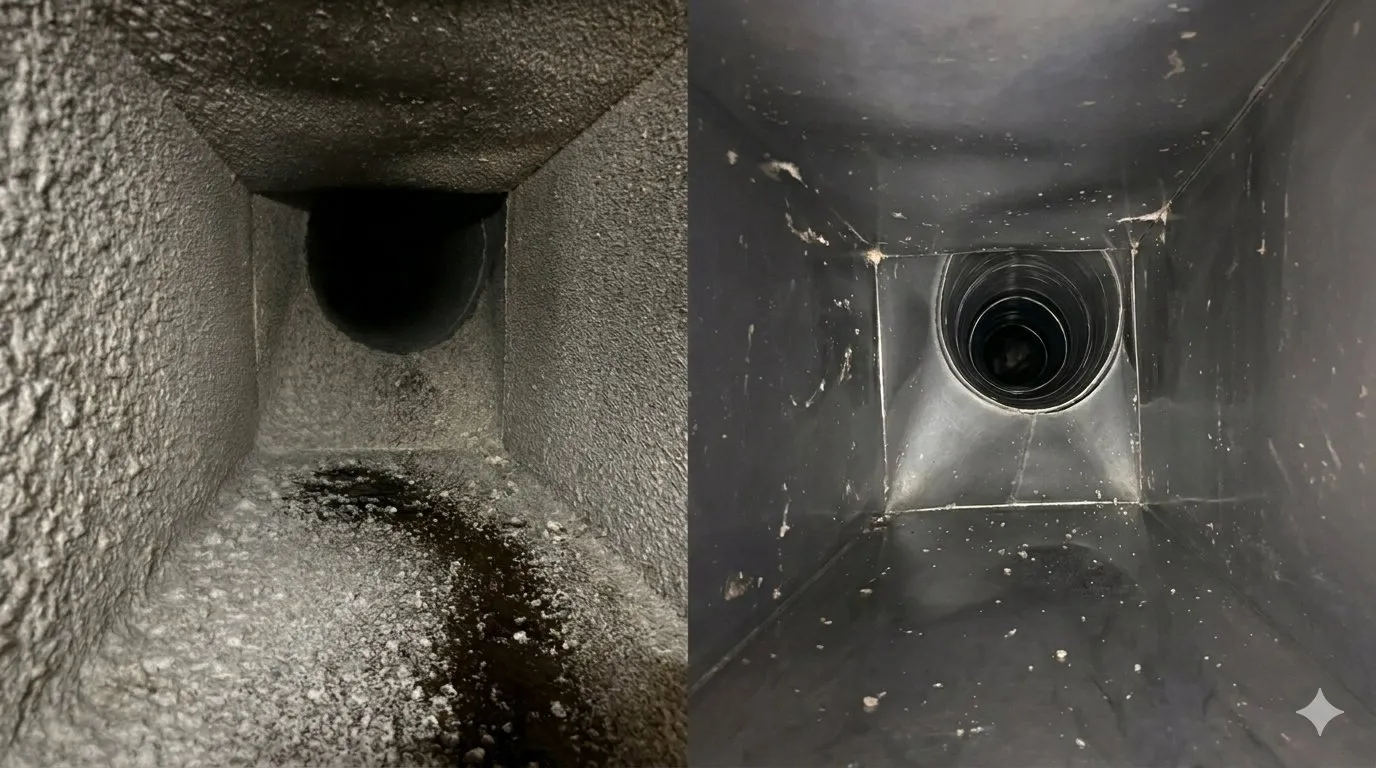
Under TR19® Grease, the mean grease thickness should stay at or below 200 microns between cleans, while a reading of 500 microns or more anywhere calls for immediate spot cleaning. Grease testing shows which side of those lines you are on. If you have extracts that may be over the 200 micron mean and systems that need surveying before cleaning, we can help, from post-clean checks, access surveys and insurer audits onwards.
Rural kitchens often have long, low duct runs through a roof space or along an outside wall, where grease settles in the flat sections. We agree access and timings in advance.
For insurers and inspectors, the record counts. That’s why every job is written up in a report with photos, plus a TR19® certificate through the BESCA VHE portal where the work is a TR19® Grease clean.
- Where
- Cross End (CO9)
- Region
- Essex
- Paperwork
- TR19® certificate and photo report
- Quote
- Fixed quote, usually within a working day
- When we work
- When your site is closed, plus a 24/7 line
- Phone
- 0345 646 2711
- Page updated
- 30 October 2026
What TR19 inspection looks like in Cross End
The fire and rescue service for Cross End is Essex County Fire and Rescue Service. Grease in a kitchen extract is a recognised fire risk, and the fire authority enforces the law on managing it in most commercial premises. It’s Braintree council that sends environmental health officers to food businesses in Cross End. The cleanliness of the kitchen and its equipment, extraction included, is part of what they check. Our report lists what was cleaned and when, which is useful to have ready.
If you run catering at a historic house or estate in the area (Hedingham Castle is about 4.7 miles west), event kitchens in older buildings often have awkward duct runs that need planning. If you run a church or community hall kitchen, near Parish Church of St John the Baptist or elsewhere in Cross End, its extract still collects grease from every lunch and event.
Cross End is about 4 miles north-east of Halstead, in Essex. We carry out TR19 inspection for commercial premises of every kind in Cross End and the rest of Essex. Cross End is one of 644 towns, villages and districts in Essex we cover for TR19 inspection. Our Chelmsford page covers sites nearby (19 miles or so).
We cover every part of CO9 for TR19 inspection and the streets around it. We also cover the places around Cross End: Alphamstone (2 miles north-east), Lamarsh (2 miles north-east), Bures (3 miles east), Mount Bures (3 miles east) and White Colne (3 miles south). Further out, we also cover Colchester (10 miles south-east), Braintree (9 miles south-west), Witham (12 miles south), Camulodunum (9 miles south-east), Halstead (4 miles south-west) and Greenstead (11 miles south-east).
Around Cross End
We work in commercial kitchens and buildings around The King's Head Public House and the streets around them. The closest station to Cross End is Bures station, roughly 2.7 miles east of the centre. Well-known places in the area include Mount Bures (2.9 miles east) and Halstead Hospital (3.3 miles south-west). For a walk, there’s Sergeants Orchard.
What affects the cost of TR19 inspection
We quote each job individually. These are the things that affect it:
- Whether several sites go on one quote
- The condition of the system
- When the work can happen, such as evenings, overnight or weekends
- Site rules, permits and inductions
One small site or a whole estate, we price it on the same basis: the work involved, the access and the timing. You’ll have a fixed price before any work starts.
What to send for a quote
We can often survey from pictures. Try to include:
- How we’d reach plant on a roof or in a plant room
- Your last certificate, test record or report
- Your opening hours and when the area is out of use
- Wide pictures of the system and the area around it
Photos are the quickest way to a quote: wide shots of the system, close-ups of anything that worries you and how we’d get to it. Add the site type and your opening hours, and many jobs can be priced from that alone.
What we are called out for in Cross End
TR19® is the benchmark that insurers, fire officers and EHOs refer to. TR19® itself is not law, but the Regulatory Reform (Fire Safety) Order 2005 requires the responsible person to assess and reduce fire risk, and in a kitchen that means keeping grease under control.
Any of these means the system needs a check-up:
- Sites with gaps in their extract records
- Kitchen extract systems with no recent grease readings
- Insurance renewals needing proof of TR19 cleaning
- Systems that need surveying before cleaning
Healthcare kitchens cannot easily close, so their extracts are cleaned overnight or between meal services; the nearest hospital to Cross End is Halstead Hospital, about 3.3 miles south-west.
What your quote should include
- Whether inaccessible sections are listed on the report
- Their accreditations, such as BESCA Vent Hygiene Elite, CHAS or SafeContractor
- What’s included in the scope, part by part
- If they look at the system before pricing
Places near Cross End
What else we do in Cross End
How the visit works
Your trading hours come first. Most visits are booked for when the area is out of use, such as evenings, overnight, early mornings or weekends. Once we are in, the area is sheeted and anything that has to be off is turned off and cooled, and the job takes an hour or two for a single kitchen, longer for a large or complex system. A quick note on how to find the site and where to park makes a visit to Cross End run smoothly.
- After the clean, we arrange a time to check the system.
- The same access points are opened up.
- We repeat the WFTT or DTT readings.
- Photos are taken to show the condition after the clean.
- The results are reported, with anything missed flagged.
Before we arrive
- Let us know about permits to work or site inductions
- Mention any parking or loading restrictions
- Let us know when the site is closed or quiet
Getting a quote
We do not publish a price list, because no two systems are the same. Instead, we look at your site first, from pictures or a survey, and then send you a fixed quote. To get going, call 0345 646 2711 or email us.
Advice
FAQs for Cross End
Do you work at weekends in Cross End?
Yes. We work evenings, overnight and at weekends. The work in Cross End can fit around your hours. Just give us a ring on 0345 646 2711, or email photos with your opening times and we’ll plan around them.
Who inspects food businesses in Cross End?
Kitchens in Cross End are inspected by Braintree council’s environmental health officers. Have your latest TR19® certificate and photo report to hand, as an officer may ask how the extract is maintained.
Do we have to follow TR19 by law?
No. It’s the benchmark rather than the law. In practice, an insurer can refuse or reduce a claim without proof of TR19 cleaning, so it matters in practice.
What’s TR19?
A BESA specification, with two parts that matter most here: TR19® Grease for kitchen extracts and TR19® Air for supply and extract systems. It is not law, but it’s the benchmark.
Can you set up regular visits?
Yes, of course. Send details of the systems and how they’re used and we will propose a schedule with a fixed quote.
What is grease thickness testing?
It’s a measurement of how much grease is coating the inside of the extract, by WFTT or DTT. The results are given in microns.
Do you offer emergency callouts?
Yes. Our emergency line runs 24/7 for anything that can’t wait until a planned visit. Ring any time and tell us what’s happened.
What accreditations do you have?
CHAS, SafeContractor, ISO 9001 and BESCA Vent Hygiene Elite membership, cleaning to BESA TR19® Grease. We are fully insured and have been trading since 2009.
What a clean won’t put right
We will not sell you work that does not address the problem, so these are the things it will not cover:
- The responsible person’s own fire risk assessment
- Design faults in the extract system
- A faulty or failing extract fan
If in doubt, ring 0345 646 2711, or send details by email and we will say what we think.
Parts of the system we cover
- Pre-clean surveys
- Post-clean checks
- Deposit thickness tests
- Insurer audits
- Access surveys
- Wet film thickness tests
Keeping the system healthy
Results last longer with the right care. We suggest:
- Keep canopy edges and gutters wiped down
- Do not box in or cover duct access panels
- Look out for grease drips round the canopy edge
- Keep grease filters clean and fitted properly
Any access problems we found are listed with a suggested fix. Fitting them before the next clean means the whole system gets done.
Fit access panels where the survey finds sections can’t be reached, so grease isn’t left building in hidden parts.
Different parts, different methods
Horizontal duct runs
Bends and long runs can hold heavy deposits, well away from where anyone looks.
Restaurants, pubs and hotels
Heavy use under BESA guidance, 12 to 16 hours a day, means a clean at least every 3 months, and readings show whether that is enough.
What your team can do, and what needs us
Day-to-day cleaning is something your team can do: wiping down canopy surfaces, cleaning filters and keeping a simple log. What they cannot safely do is clean inside the ductwork, the fan or the risers, which is where we come in.
Logging matters as much as cleaning. A simple log of filter washes, wipe-downs and checks shows an inspector that the system is looked after between visits, alongside our reports.