Thurrock · Extract fan cleaning
Low Street extract fan cleaning
We cover Low Street for cleaning of kitchen extract fans, impellers, fan housings and discharge points. Out-of-hours visits, a fixed quote and a written report with pictures as standard.
- Grease escaping from the fan outlet
- A noisy fan that has got louder over time
- A smell of hot grease from the extract
Common problems we fix in Low Street
Fans that are hard to reach are often the ones that get missed. If it wasn’t included in past cleans, it may hold years of grease, and the report will show it.
Any of these means the system needs a check-up:
- Less air being pulled from the kitchen
- A heavily greased fan housing
- Fat spreading onto the roof or wall by the fan
- An extract fan with no cleaning record
Bursars and site managers at schools such as East Tilbury Primary School tend to book extract cleaning for when the kitchen is empty.
What your quote should include
- Whether they’re fully insured
- What’s included in the scope, part by part
- When the next visit should be, and why
- What records you’ll receive afterwards
Extract fan cleaning for kitchens and businesses in Low Street
Is the extract fan louder than it used to be, or the airflow weaker? A few details or a photo help when you phone us on 0345 646 2711 or drop us a line, and you will get a fixed price, normally within one working day. The work covers fan housings, axial fans and roof-mounted fans, and the jobs we see most are a fan that hums, whines or rumbles and a fan shaking on its mounts.
Work in a small place like Low Street starts with a call to agree access and timings, and the clean itself is the same full TR19® job as in any town: canopy to discharge, then a TR19® certificate and a photo report.
The paperwork matters as much as the work. Each visit is written up with photos, covering the work done, any areas we couldn’t access and a recommended next date. File it in your maintenance log so it’s ready for an insurer, fire officer or EHO.
- Location
- Low Street (RM18)
- Wider area
- Thurrock
- Records
- Certificate and photo report
- Quote
- A fixed quote up front
- When we work
- Evenings, overnight and weekends; 24/7 emergencies
- Telephone
- 0345 646 2711
- Last updated
- 30 October 2026
Low Street kitchens: local notes
Low Street lies within about 1 mile of the sea. Corrosion on the fan housing and cowl is worth a look at every clean, alongside the grease. Food Standards Agency data counts about 5 cafés, restaurants and staff canteens and about 8 takeaways and sandwich shops across Low Street and its immediate surroundings (about a mile and a half). Grease builds up on fan blades and housings in kitchens like these, unbalancing the impeller. The fire and rescue service for Low Street is Essex County Fire and Rescue Service. In most workplaces, including commercial kitchens, it’s the fire and rescue authority that enforces the Fire Safety Order.
If you run a café or takeaway near East Tilbury station, early starts and late finishes leave little time to clean, so overnight extract cleaning suits. Kitchens that cook twelve hours or more a day, as some healthcare kitchens do, fall into BESA’s three-monthly minimum; Gravesham Community Hospital is the nearest hospital to Low Street, about 2.6 miles south-west.
Low Street is about 3 miles east of Grays, in Thurrock. Every kind of commercial site in Low Street, we can take on extract fan cleaning. Visits can be booked for evenings, overnight or weekends so the site keeps running. Our Thurrock coverage runs to 26 places, Low Street among them. You can also see our page for Maidstone, roughly 15 miles from Low Street.
We cover every part of RM18 for extract fan cleaning and the roads nearby. Streets in the area include Station Road and Low Street Lane, all of which we cover for extract fan cleaning. If your site is just outside Low Street, we cover East Tilbury (1 mile north-east), Linford (1 mile north), Chalk (3 miles south), Church Street (4 miles south-east) and Lower Higham (4 miles south-east). Larger places within reach include Stanford-le-Hope (4 miles north-east), Grays (3 miles west), South Ockendon (6 miles north-west), Balstonia (3 miles north), Corringham (4 miles north-east) and Aveley (7 miles west).
Local landmarks in Low Street
Around Low Street, our work takes us to kitchens and buildings near The Gateway Academy and The Kings Head pub, among other places. The nearest railway station is East Tilbury station, about 0.9 miles north-east of the centre. Well-known places in the area include Gravesham Community Hospital (2.6 miles south-west) and Walton Hall Museum (1.5 miles north). For a walk, there’s Thurrock Thameside Nature Park and Sawyers Lake.
What happens if it’s left?
A fan that fails mid-service can stop a kitchen cooking. Grease is often where fan trouble begins, so keeping it clean is part of keeping it running. We also offer a 24/7 emergency callout if the worst happens. Somewhere as small as Low Street, losing a kitchen or building to a fault is felt by everyone who uses it.
Combining work into one visit or one programme often makes better use of the time. Tell us about everything you’d like looked at and we’ll price it together.
Why Low Street businesses choose us
- Every job surveyed first
- Work around your opening hours, with 24/7 emergency cover
- BESCA Vent Hygiene Elite member, cleaning to BESA TR19® Grease
- A written report with photos after every visit
Take a look at our cost guide or our accreditations and certificates.
What the work involves, part by part
Fan housings and motors
We clean around the motor without soaking its electrics, and the fan is isolated throughout. Grease around the motor can make it run hotter, so the surrounding area is cleaned carefully.
Kitchens with long cooking hours
A long-hours kitchen can’t afford a fan failure. A clean fan is less likely to strain, and our 24/7 emergency callout is there if it happens anyway.
Looking after it afterwards
No system stays clean for ever, but care slows the build-up. Our tips:
- Report grease escaping from the fan
- Leave a clear route to the fan
- Notice when the fan starts to sound different
- Keep each photo report with the maintenance log
Once it’s clean, the fan is closed up and run to check it’s working smoothly. If anything seems wrong, from vibration to wear, we note it, so you can plan any repair.
Keep the route to the fan clear. A fan that can be reached safely is a fan that gets cleaned, whether it’s on a roof, in a ceiling or on a wall.
What we do, step by step
Every visit runs to the same pattern: protect the area, isolate whatever needs isolating, carry out the extract fan cleaning, tidy up and hand over the paperwork. The visit itself takes a couple of hours per fan, depending on its size and the build-up. If you can send photos, we can arrive in Low Street knowing what to expect.
- First we locate the fan and agree how it’s safely isolated.
- With the fan isolated, the housing is opened.
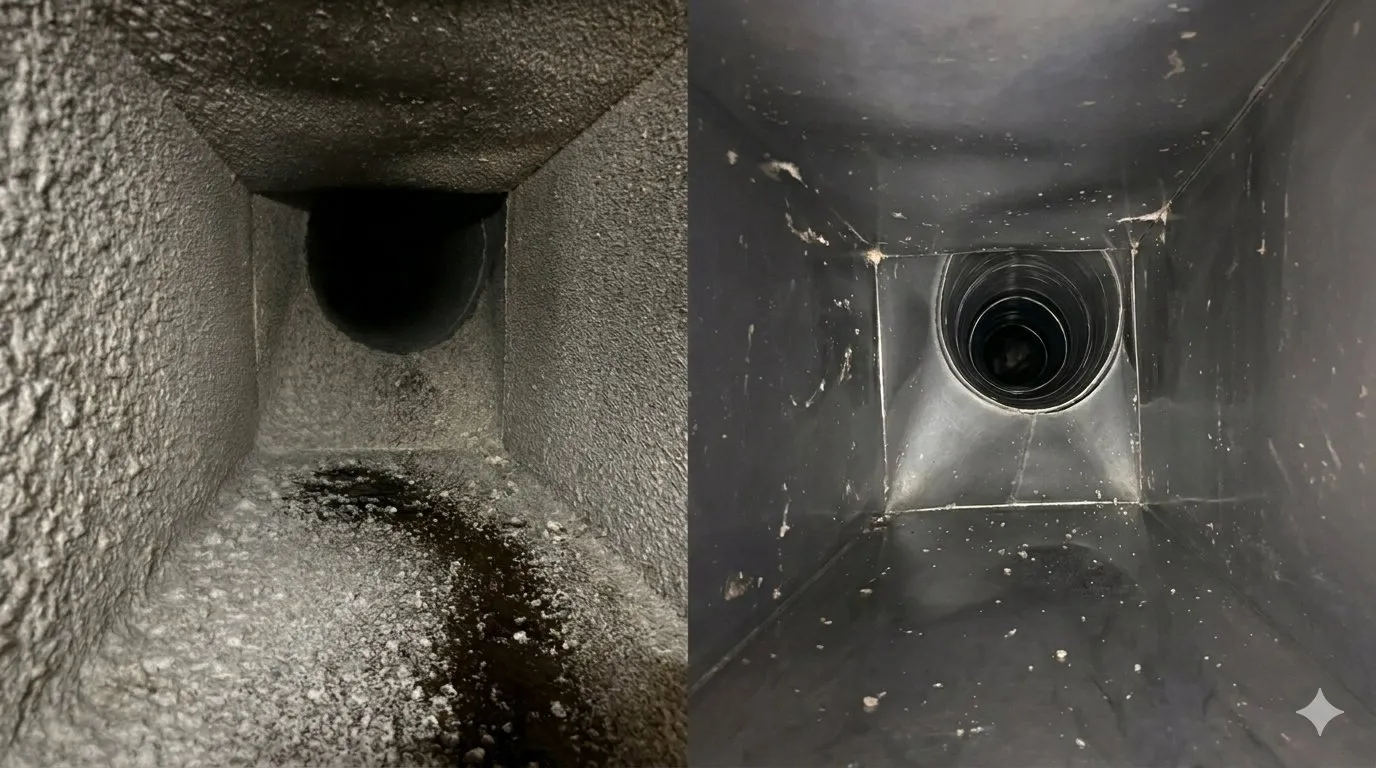
- The impeller and the housing around it are scraped clean.
- We degrease the fan and housing, taking care around the motor.
- We reassemble, run the fan and photograph the result.
Preparing for the visit
- Make sure equipment near the work can be switched off and left to cool
- Let us know about permits to work or site inductions
- Let us know how we reach the system, including roofs, risers and plant rooms
How to get a quote
Every quote begins with a look at the system, either from photos and details you send or from a site visit. After that, you get a fixed price for the work so you know the cost before work begins.
Read more
Your questions about extract fan cleaning in Low Street
Is extract fan cleaning any different in a coastal place like Low Street?
Yes, to a degree: at about 1 mile from the coast, Low Street gets salt-laden air that corrodes metal faster. Corroded fixings and housings are noted on the report so they can be dealt with.
Who enforces fire safety at workplaces in Low Street?
It’s Essex County Fire and Rescue Service, which covers Low Street. It’s worth keeping your fire risk assessment, TR19® certificates and photo reports together, ready to show.
Do you repair extract fans as well as clean them?
Anything beyond cleaning is flagged, with what we found. We offer extract fan repair and replacement, and there’s a 24/7 emergency callout for breakdowns.
How much does extract fan cleaning cost in Low Street?
It depends on the site, so we quote each one individually. For a quote, phone us on 0345 646 2711, or send details by email and tell us about the site and its opening hours.
Is TR19 a legal requirement?
Not in itself. Insurers, fire officers and EHOs look to TR19® as the benchmark, and many insurance policies ask for proof of TR19® cleaning. The law behind it is the Fire Safety Order 2005 in England and Wales.
How do you protect the area?
Floors and surfaces near the work are sheeted before work begins, and anything we remove is contained. At the end, the area is cleaned down.
Can you look after several sites?
Yes. Our area covers London and the South East, so we can schedule a run of sites as one programme. Each site gets its own report and photos.
What happens if you cannot reach some of it?
We never leave them off the paperwork. The report says which parts couldn’t be reached and why, along with a quote to put access in.
Landlords, agents and facilities managers
The Fire Safety Order 2005 puts the duty to manage fire risk on the responsible person, which may be the employer, owner, landlord, FM or managing agent. Where responsibility is shared, records matter even more.
Managing agents often deal with us directly. Send the address, what’s needed and how access works, and we’ll send a fixed quote.
Places near Low Street
Other services in Low Street
When it’s something else
We won’t sell you work that does not address the problem, so here are the limits:
- A failed motor or worn bearings (that needs a fan repair or replacement)
- An impeller that’s bent or split
- A fan that is too small for the system (a design question)
Not sure which it is? You can call us on 0345 646 2711 or drop us a line and we will tell you honestly.
Where we work
- Fan housings
- In-line fans
- Centrifugal fans
- Roof-mounted fans
- Axial fans
- Discharge points