Oxfordshire · Extract fan cleaning
Didcot extract fan cleaning
Cleaning of kitchen extract fans, impellers, fan housings and discharge points for businesses, landlords and public buildings in Didcot. BESCA Vent Hygiene Elite member, cleaning to BESA TR19® Grease.
- Less air being pulled from the kitchen
- A fan coated in grease inside its housing
- Hot, greasy smells near the fan
The process
Everything the job needs comes with us, including protection sheets, the right tools and access kit. You only need to give us clear access and switch off what needs to be off. The visit takes a couple of hours per fan, depending on its size and the build-up. A closed day, an evening or an early start: whichever suits your site in Didcot, we’ll book around it.
- Diagnosis first: we look for grease, noise and vibration.
- Once isolated, we open the fan up.
- Each blade is cleaned so the impeller runs evenly.
- Housing, outlet and the area around the motor are cleaned.
- We run the fan and note its condition in the photo report.
How to prepare
- Make sure equipment near the work can be switched off and left to cool
- Make sure someone can let us in and lock up afterwards
- Clear loose items from the work area
How to get a quote
To get a fixed quote, phone us on 0345 646 2711 or use the quote form with the site type, your trading hours and a short description of the system. A few photos and your last certificate or report help a lot. We normally come back within one working day.
Read more
Extract fan cleaning in Didcot
Every kitchen extract depends on its fan: it pulls air from the canopy, through the duct and out of the building. Whatever grease slips past the filters and duct reaches the fan, and that’s what we clean. If you have a fan left out of previous cleans and thick grease on the impeller and casing, we can put it right.
In a town like Didcot, most of the kitchen extracts we’re asked about belong to restaurants, cafés, pubs, takeaways and school or care home kitchens. Whatever the kitchen, the canopy, filters, duct and fan all collect grease.
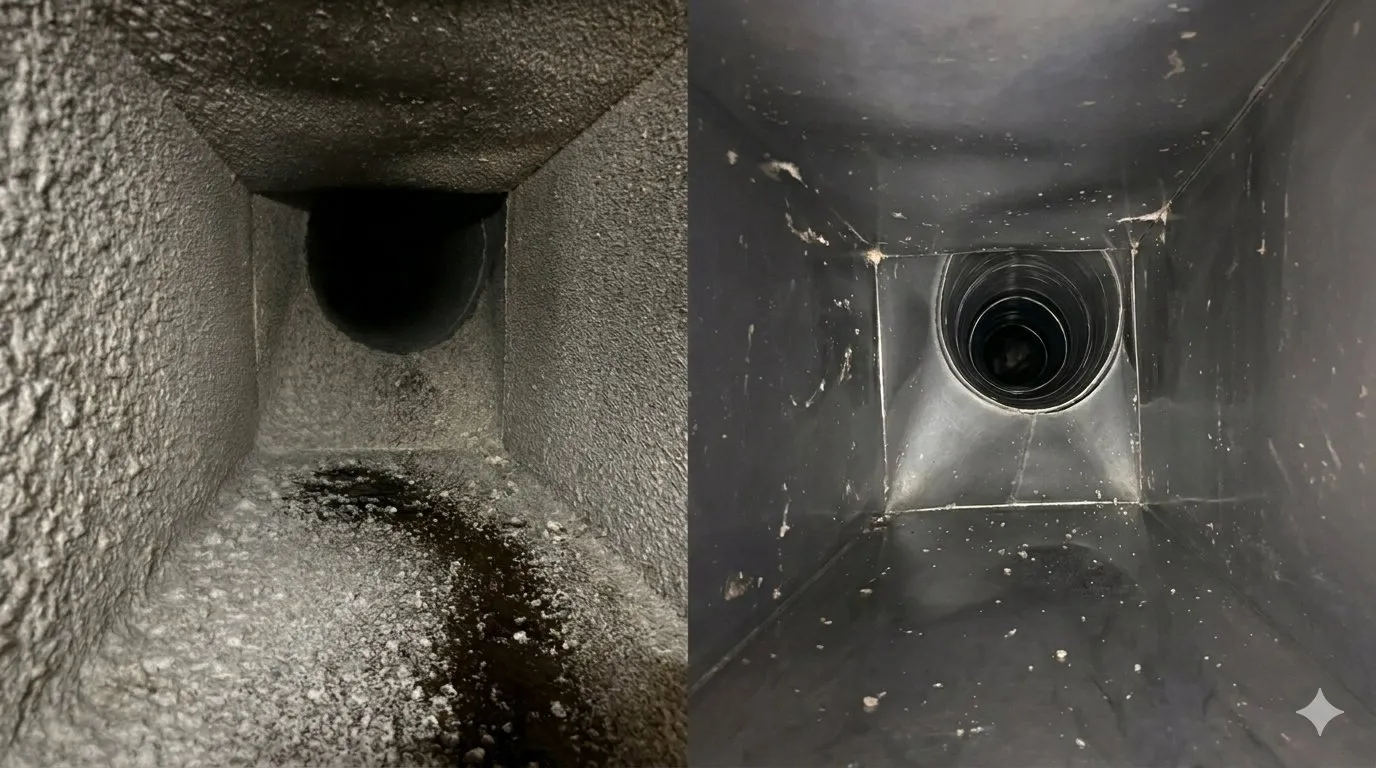
Good records are part of the job. Each visit is written up with pictures, covering the work done, any areas we couldn’t access and a recommended next date. Keep it with your fire safety records so it’s ready for an insurer, fire officer or EHO.
- Where
- Didcot (OX11)
- Region
- Oxfordshire
- Reporting
- Certificate plus before-and-after photos
- Price
- A fixed quote up front
- When we work
- When your site is closed, plus a 24/7 line
- Telephone
- 0345 646 2711
- Checked
- 30 October 2026
What affects the cost of extract fan cleaning
Before we fix a price, we need to know a few things. We check:
- The scale of the work
- How many systems or sites are involved
- The condition we find in the survey
- Where the site is and how we reach it
The cost depends on how big the system is, what state it’s in and how easy it is to reach. You get a fixed price before we start, so you know where you stand.
What we need to know
Before you ask for a quote, gather:
- Wide photos of the system and the area around it
- Your opening hours and when the area is out of use
- Close-ups of filters, grilles, hatches or access panels
- Where the plant sits or the system leaves the building, such as a roof or outside wall
Quotes are quick. Call or email with a few details and you will typically have a fixed price within one working day. If we need to see the system first, we book a survey around your hours.
Extract fan cleaning around Didcot
The FSA’s data shows about 11 bars, pubs and nightclubs registered in Didcot and the streets around it, up to about 1.5 miles out. Where they serve hot food, their kitchen extracts need cleaning to TR19® like any restaurant’s. Oxfordshire Fire and Rescue Service covers Didcot. Its fire safety officers can audit commercial kitchens, and grease in the extract is part of a kitchen’s fire risk. It’s South Oxfordshire council that sends environmental health officers to food businesses in Didcot. An officer looking round a kitchen will see the canopy, and grease there is hard to miss. Before-and-after pictures from each clean are a simple way to show the extract is in hand.
If you cook for passing trade around Didcot Parkway station, the extract can be cleaned between your last and first customer. Where a hall near Church of All Saints, or anywhere in Didcot, hosts lunch clubs or events, its extract gathers grease just as a café’s does.
Didcot is about 10 miles south of Oxford, in Oxfordshire. If you need extract fan cleaning in Didcot, it’s easy to get a fixed quote: please give us a ring on 0345 646 2711 or email us. We work across South East England and London, Didcot included. We cover 443 places across Oxfordshire, from busy centres to quieter spots. Our Oxford page covers sites nearby, about 10 miles away.
We work across the OX11 postcode area for extract fan cleaning and the roads nearby. Streets in the area include Station Road, Market Place and High Street, all of which we cover for extract fan cleaning. You will find Didcot on the A4130 and B4016, so it’s easy for us to get to for extract fan cleaning. We also cover the places around Didcot: Great Western Park (1 mile west), Appleford-on-Thames (2 miles north), Milton (2 miles north-west), Sutton Courtenay (2 miles north-west) and Long Wittenham (3 miles north-east). Larger places within reach include Oxford (10 miles north), Abingdon-on-Thames (5 miles north), Thame (15 miles north-east), Wantage (8 miles west), Grove (8 miles west) and Faringdon (15 miles west). As one of the bigger places in Oxfordshire, Didcot has a wide mix of commercial premises, all within our area for extract fan cleaning.
Local landmarks in Didcot
Typical jobs here are in premises near Didcot Girls' School, The Queens Arms and UTC Oxfordshire, among other places. Didcot has its own railway station: Didcot Parkway station. Nearby you will also find Abingdon Community Hospital (4.8 miles north-west) and Brightwell Castle (3.4 miles east). Not far away are Mowbray Fields and Wittenham Clumps.
Multi-site and managed buildings
For anyone managing more than one site, we can plan visits across the whole estate and price them together. Each site gets its own report and photos, so records stay tidy.
From a single site to a large estate, the standard is the same: a survey first, a fixed quote, the work timed around the site and a report with pictures.
Between visits
A little care between visits keeps the system in better shape. Our advice:
- Leave a clear route to the fan
- Tell us if the extract feels weaker
- Never cook with a filter missing
- Book the fan into every full TR19 clean
When we have finished, the fan is reassembled and run. Anything we notice, like noise, vibration or a worn part, goes on the report, so you can plan any repair.
The fan stays cleaner when less grease gets past the canopy. Keep the grease filters clean, fitted and in place, and replace any that are damaged.
Also near Didcot
Also in Didcot
Questions from Didcot
Can you come to Didcot after we close?
Yes, evening, overnight and weekend work is normal for us. The site is handed back ready to open. Just give us a ring on 0345 646 2711 or send us an email with your opening times and we’ll plan around them.
Which fire and rescue service is responsible for Didcot?
Fire safety enforcement in Didcot is handled by Oxfordshire Fire and Rescue Service. If a fire safety officer visits a commercial kitchen, they may ask about the fire risk assessment and how the extract is kept clean.
Is TR19 cleaning required by law?
No. TR19® is BESA’s specification, not legislation. The law is the Regulatory Reform (Fire Safety) Order 2005, which makes the responsible person assess and reduce fire risk, and cleaning to TR19® is the recognised way to show grease is under control.
What happens to the waste?
It leaves the site with us at the end of the visit. During the work, it’s contained so the area stays clean.
How do you protect the area?
With sheeting and covers, before anything else happens. The work is kept contained and clean down when we finish.
Are you accredited?
We are a BESCA Vent Hygiene Elite member, cleaning to BESA TR19® Grease. We also hold CHAS, SafeContractor and ISO 9001, and we’re fully insured.
What paperwork do I get after a fan clean?
You get a photo report with before and after photos of the fan. If it’s part of a full TR19 clean, a TR19 certificate is issued too.
What’s the cleaning interval for an extract fan?
Daily cooking hours set the minimum in BESA guidance. Heavy use means at least every 3 months, light use at least every 12, fan included.
How the job changes from site to site
Kitchens with long cooking hours
When a busy kitchen’s fan fails, cooking stops. Keeping the fan clean is part of avoiding that, and our 24/7 emergency callout is there if it happens anyway.
Inline duct fans
Inline fans sit within the duct run, often above a ceiling. We get to them through the duct or casing, once they’re isolated.
What extract fan cleaning cannot fix
We won’t sell you work that doesn’t address the problem, so these are the things it won’t cover:
- A fan that was never right for the kitchen
- A cracked or broken impeller (it needs replacing)
- Grease in the duct and canopy before the fan (those need a full TR19 clean)
Not sure which it is? You can call 0345 646 2711 or send us an email and we’ll tell you honestly before booking.
Parts of the system we cover
- Fan housings
- Centrifugal fans
- Axial fans
- Roof-mounted fans
- Discharge points
- In-line fans
Do you need extract fan cleaning in Didcot?
How fast a fan gets greasy in Didcot depends on the cooking: how many hours a day the kitchen runs and what it cooks. Under BESA guidance, the whole system, fan included, needs cleaning at least every 3, 6 or 12 months depending on daily hours.
It’s time to book a visit if you see:
- A smell of hot grease from the extract
- A fan that hums, whines or rumbles
- Weak extraction at the canopy
- An extract fan with no cleaning record
If you run catering at a healthcare site, such as a hospital like Abingdon Community Hospital about 4.8 miles north-west, the extract may need cleaning more often than a part-time kitchen.
What your quote should include
- What hours they’ll be on site
- Whether a written report and pictures are included
- Whether inaccessible sections are listed on the report
- Whether the quote shows VAT