Hampshire · Extract fan cleaning
Lower Swanwick extract fan cleaning
Extract fan cleaning for Lower Swanwick, from a team that has been trading since 2009. Evenings, overnight and weekends, plus a 24/7 emergency line.
- An extract fan with no cleaning record
- Fat spreading onto the roof or wall by the fan
- Hot, greasy smells near the fan
Extract fan cleaning in Lower Swanwick: the local picture
At about 2 miles from the coast, Lower Swanwick is close enough for sea air to matter. Metal on the roof weathers faster close to the coast, and the extract fan and cowl are no exception. The Food Standards Agency lists about 10 bars, pubs and nightclubs as registered food businesses in and around Lower Swanwick, up to about a mile and a half out. Wherever they cook, the canopy, duct and fan collect grease just as a restaurant’s do. Food hygiene inspections in Lower Swanwick are the job of Fareham council’s environmental health team. An officer looking round a kitchen will see the canopy, and grease there is hard to miss. A dated certificate in the maintenance file answers the question before it’s asked.
Bursars and site managers at schools such as Bursledon Church of England Infant School tend to book extract cleaning for when the kitchen is empty. Healthcare kitchens cannot easily close, so their extracts are cleaned overnight or between meal services; the nearest hospital to Lower Swanwick is Coldeast, about 1.2 miles south-east.
Lower Swanwick is about 2 miles west of Whiteley, in Hampshire. Across the SO31 area, we can carry out extract fan cleaning at your premises. Our area takes in 683 places across Hampshire, large and small.
Every address in SO31 is within our area for extract fan cleaning, from the main roads to the quietest streets. Local streets include Green Lane, Bridge Road and Station Road, all of which we cover for extract fan cleaning. Other places close to Lower Swanwick include Swanwick (1 mile south-east), Sarisbury (1 mile south-east), Sarisbury Green (1 mile south), Park Gate (2 miles south-east) and Burridge (2 miles east). Larger places within reach include Winchester (12 miles north), Gosport (8 miles south-east), Havant (14 miles east), Eastleigh (6 miles north), Fareham (5 miles south-east) and Horndean (13 miles east).
Near you in Lower Swanwick
Typical jobs here are in premises near Brookfield Community School and Language College and The Old Ship Inn, among other places. There’s a railway station in Lower Swanwick itself: Bursledon station. Other landmarks nearby include St Andrew's Castle (2.4 miles south) and Bursledon Brickworks Industrial Museum (under half a mile north-east). For a walk, there’s Swanwick Lakes.
About our extract fan cleaning in Lower Swanwick
Cleaning removes grease, not wear. If we find worn bearings, a struggling motor or damage to the impeller, we will tell you, and we also repair and replace extract fans. You will know whether the fan just needed cleaning or something more. If you have an extract fan that vibrates or rattles and fat spreading onto the roof or wall by the fan, we can put it right.
In a village or hamlet like Lower Swanwick, the kitchens that need extract cleaning are normally a pub, a school, a care home or a hall kitchen, wherever there is one. Every one of them still needs its extract kept clear of grease.
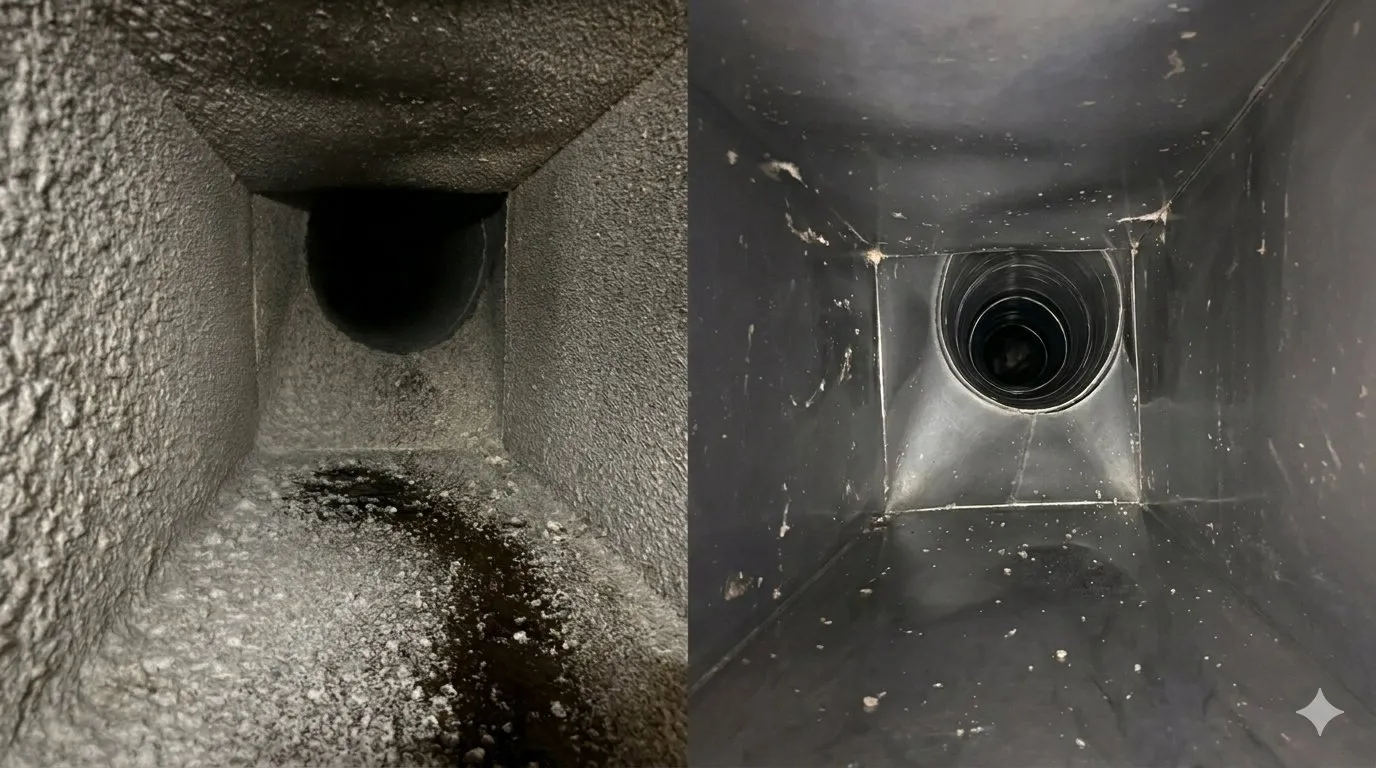
Good records are part of the job. You get a written report with pictures after each visit, covering the work done, any areas we couldn’t access and a recommended next date. File it in your maintenance log so it’s ready for an insurer, fire officer or EHO.
- Place
- Lower Swanwick (SO31)
- Wider area
- Hampshire
- Records
- TR19® certificate and photo report
- Quotes
- Fixed quote, normally within a working day
- Working hours
- Overnight and weekend work, 24/7 emergency callout
- Telephone
- 0345 646 2711
- Reviewed
- 30 October 2026
Common problems we fix in Lower Swanwick
Fans that are hard to reach are often the ones that get missed. A fan that has never been cleaned can be heavily coated, and the report will show it.
Signs it’s time to call us include:
- A motor area thick with grease
- Weak extraction at the canopy
- A fan left out of previous cleans
- Hot, greasy smells near the fan
A hall kitchen that only cooks for events, whether near Church of St Leonard or elsewhere in Lower Swanwick, still needs its extract cleaned, just less often.
What to look for in a quote
- Whether they recommend a next date
- Whether a survey comes first
- Whether the whole system is included, or only the parts that are easy to reach
- What hours they’ll be on site
Landlords, agents and facilities managers
If you look after several sites, we can schedule visits across all of them on one quote. Each site gets its own report and pictures, so records stay tidy.
Under the Regulatory Reform (Fire Safety) Order 2005, the responsible person must assess and reduce fire risk, and that can be the employer, the owner, a landlord, a facilities manager or a managing agent. With shared responsibility, good records help everyone.
Your questions about extract fan cleaning in Lower Swanwick
Do you cover smaller places like Lower Swanwick?
Yes. Lower Swanwick is within the area we cover across London and the South East. A survey first, from pictures or a visit, means we arrive with the right kit.
Do you clean school canteen extracts around Lower Swanwick out of term?
Yes. Half-terms and the summer break are the natural time for school work. Food Standards Agency records list about 7 schools, colleges and universities with registered kitchens within about a mile and a half of Lower Swanwick. Tell us your holiday dates and we’ll book the visit for when the site is empty.
Is TR19 cleaning required by law?
No, not in itself. TR19® is the benchmark insurers, fire officers and EHOs check against, and many insurance policies ask for proof of TR19® cleaning. The law behind it is the Fire Safety Order 2005 in England and Wales.
How often does the fan need cleaning?
With the whole system, at intervals set by BESA guidance: from 3-monthly for heavy use to 12-monthly for light use. A noisy or heavily coated fan may need it sooner.
Do we need to close while you work?
Normally not. Booking the work out of hours means the site can carry on as normal. Bigger sites can be done in stages so parts stay in use.
How do you protect the area?
Floors and surfaces near the work are sheeted before any work starts, and anything we remove is contained. Before we leave, we tidy up and clean down.
Can one contract cover all our sites?
Yes. We work across South East England and London, so we can schedule a run of sites as one programme. Each site gets its own report and pictures.
Do you have a 24/7 line?
Yes. For anything urgent, such as a fan failure or damage after a fire, ring the 24/7 line and we’ll talk you through the next steps.
Aftercare tips
Simple habits between visits make a real difference. We recommend:
- Run the extract throughout cooking
- Keep access to the fan clear
- Report grease escaping from the fan
- Make sure the fan is included each time
A full system clean includes a TR19 certificate from the BESCA Vent Hygiene Elite portal. If only the fan is cleaned, the photo report says so.
Stick to the interval for the full extract. A fan cleaned with the rest of the system on time rarely gets badly coated, in line with BESA guidance.
What affects the cost of extract fan cleaning
A fixed price needs a few facts first. We check:
- Where the site is and how we reach it
- When the work can happen, such as evenings, overnight or weekends
- The size of the system
- The number of sites or systems
When the work has to happen, how we reach it and how big the site is all affect the cost. Each of those is built into the quote, and the price is fixed before we start.
Helping us quote
The more you tell us, the more accurate the quote. With your enquiry, please include:
- Your opening hours and when the area is out of use
- Any previous report or certificate
- Where the plant sits or the system leaves the building, such as a roof or outside wall
- Where the site is and what kind of site it is
To help us quote: the address, the type of site and when it’s open, photos of the system and the last certificate or report, if there is one. Then phone us on 0345 646 2711 or email us.
What happens on the day
We start by comparing what we find with the survey or your photos. If anything is different, we talk it through with the person on site before carrying on. After that, the work takes a few hours where there are several fans or heavy deposits. For a village or hamlet like Lower Swanwick, tell us about narrow lanes, gates and parking when you book.
- We locate the fan and plan how to reach and isolate it.
- We isolate the power before opening the housing.
- Grease is scraped off the impeller blades and casing.
- The fan is degreased, taking care around the motor.
- We reassemble, run and photograph the fan.
Before we arrive
- Allow time for equipment near the work to be turned off and cool down
- Mention any parking or loading restrictions
- Tell us about site rules, permits or sign-in
How to get a quote
Getting a quote does not take long. Call or email with a few details and you will normally have a fixed price within one working day. Where a survey is needed, we arrange a time that suits the site.
Read more
Also in Lower Swanwick
What extract fan cleaning cannot fix
An honest diagnosis matters more to us than a booking, so here’s what this work can’t put right:
- A faulty speed controller or isolator
- Grease in the canopy and ductwork
- A fan that’s too small for the system (a design question)
If in doubt, call us on 0345 646 2711 or send us an email and we’ll say what we think before you book.
Parts of the system we cover
- In-line fans
- Axial fans
- Fan housings
- Roof-mounted fans
- Discharge points
- Centrifugal fans
Staff cleaning versus specialist work
Your own staff can handle the daily basics: wiping canopies, washing grease filters and recording it in a log. What they can’t safely do is clean inside the ductwork, the fan or the risers, and that is where we come in.
Away from the kitchen, the in-house job is mainly checking: clear grilles, a log of filter changes and reporting anything odd. The inside of ducts and units needs a specialist.